
ISBM machines / Equipment configuration
Four-Station ISBM Machines
A four-station ISBM machine adds a separate conditioning position between preform injection and stretch blowing. This configuration should be evaluated through the bottle drawing, resin grade, preform design and complete mold package. It is not universally better than a three-station arrangement. Use documented model data to identify candidates, then confirm the conditioning method, installation scope and accepted-output target for the actual container before deciding on equipment.
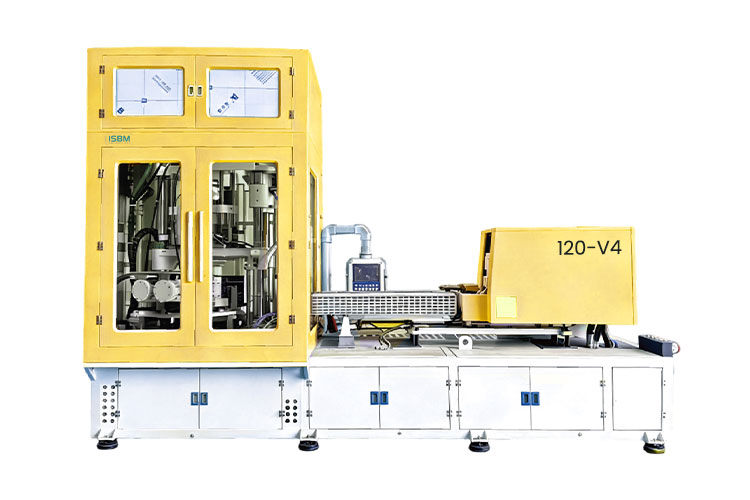
120-V4 four-station machine. See the documented model example below.
The four-station sequence
01 Injection
Form the preform in the selected injection tool. Match the shot, resin and neck arrangement to the bottle.
02 Conditioning
Condition the preform at a separate position. Specify the tooling and process requirements for the intended bottle.
03 Stretch blowing
Stretch and blow the conditioned preform into the container geometry. Confirm the proposed mold and quality requirements.
04 Take-out
Remove the finished container using the agreed ejection or take-out arrangement. Include handling and clearance in the tooling review.
Model examples, not interchangeable specifications
| Model | Documented selection cue | What to check next |
|---|---|---|
| 120-V4 | Four stations with a separate conditioning position; 45 mm screw and 255 cm³ theoretical injection volume | Bottle geometry, preform design and complete interface drawings |
| 250-V4S | Four-station hybrid model with bottle-specific wide-neck layout references | Neck and body dimensions from the same cavity row; special layouts require separate review |
These examples identify different configuration packages. They are not a recommendation for every application, and the shared station count does not make the injection units, tooling envelopes or utilities interchangeable. See each model page for its full specification.
Four-station proposal checklist
| Proposal component | Required detail | Acceptance question |
|---|---|---|
| Conditioning arrangement | Method, tooling and relevant movements | Does it meet the preform and bottle requirements in the agreed trial? |
| Complete mold package | Injection, conditioning, blow and removal interfaces | Are all interfaces compatible with the selected machine? |
| Bottle layout | One matched cavity row or an engineered custom layout | Are neck, body, height and shot requirements consistent? |
| Production cell | Machine envelope, access and selected auxiliary equipment | Does the approved installation plan allow safe operation and service? |
| Output basis | Resin, bottle, cycle conditions and rejection criteria | Is the target defined as accepted bottles, not nominal motions? |
Give conditioning its own engineering definition
A separate position creates a defined step in the process; it does not by itself prove a particular wall distribution, cycle time or resin capability. The proposal should describe the preform treatment and tooling, and explain how it relates to the intended container.
Include the closure and shoulder geometry when reviewing wide-neck containers. If an existing mold is involved, check its conditioning interfaces and station movements rather than assuming that the tool can be transferred unchanged. Keep the approved configuration and trial conditions with the project record.
Plan the complete space requirement
A machine envelope is not a complete factory layout. Allow for the approved tool-access arrangement, material preparation, cooling, compressed air and product handling included in the project. Use the selected model’s installation information and the actual auxiliary equipment schedule.
Installed electrical power is not measured consumption. Keep rated loads, supply requirements and measured operating data separate. Do not use station count alone to infer energy savings, capacity or floor-space efficiency.
Select by the bottle, not by a station-count ranking
Compare three- and four-station proposals using the same bottle drawing, resin grade, quality criteria and accepted-output target. A configuration is useful only if the complete project requirements can be demonstrated. More stations do not remove the need for correct tooling and process development.
Use the ISBM machine buying guide to organize the procurement stages. This page focuses on four-station equipment selection and leaves full model specifications on their own pages.
Questions before selecting the machine
Does an independent conditioning station guarantee better quality?
No. The outcome depends on the bottle, preform, resin, tooling and process. Specify the conditioning arrangement and verify the required results in the agreed trial.
Can the largest neck value be combined with every cavity count?
No. Read each published reference as a matched row. Body, neck, height and cavity entries from different rows must not be combined.
What is needed for an existing mold review?
Provide the full mold and mounting drawings, neck-handling details, original machine reference and required station movements, including the conditioning interfaces.
Discuss Your ISBM Bottle Project
Share the bottle drawing, exact resin grade, neck dimensions, target weight and required accepted output. Include existing mold drawings when tooling reuse is part of the assessment.
The review should identify the proposed configuration, evidence needed and project-specific limitations before a supply commitment is made.