
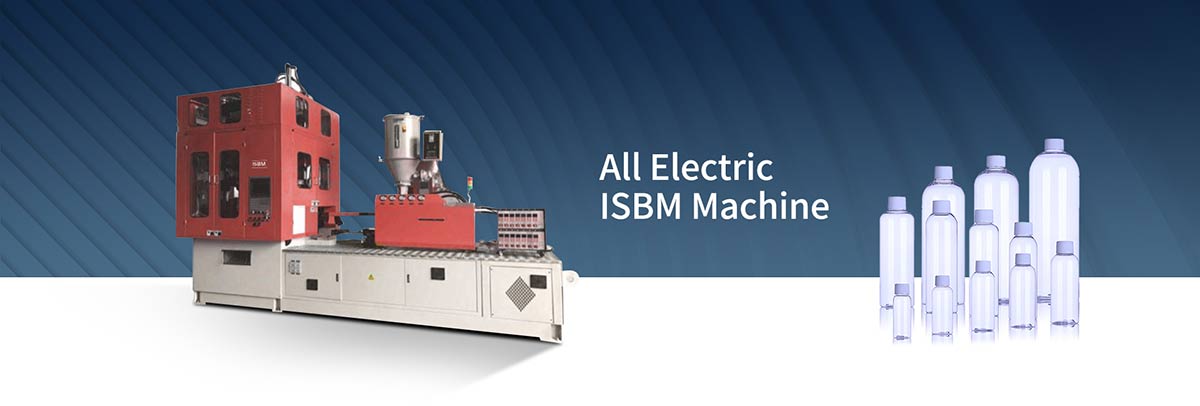
ISBM Process: How Injection Stretch Blow Molding Works Step by Step
Injection Stretch Blow Molding, commonly abbreviated as ISBM, is a manufacturing process used to produce high-quality plastic bottles and containers from thermoplastic resin.
In a one-step ISBM process, plastic resin enters one integrated molding machine and leaves as a finished bottle.
The basic process can be summarized as:
Plastic Resin → Plasticizing → Preform Injection → Thermal Conditioning → Axial Stretching → Blow Molding → Cooling → Bottle Take-Out
Unlike a conventional two-step bottle production system, the freshly injection-molded preform does not need to be completely cooled, stored, transported and later reheated in a separate blow molding machine.
Instead, the ISBM machine uses the thermal condition created during injection molding as part of the following stretch-blow process.
This integration is one of the most important characteristics of one-step injection stretch blow molding.
However, understanding ISBM requires looking beyond this simple process diagram.
The quality of the finished bottle depends on the interaction between:
- resin properties;
- preform design;
- injection molding conditions;
- preform temperature distribution;
- stretch ratio;
- stretch rod movement;
- pre-blow timing;
- blow pressure;
- mold design;
- cooling;
- and the geometry of the final container.
For this reason, an ISBM machine should be considered as one continuous thermomechanical molding system, rather than simply an injection molding machine connected to a blow molding unit.
What Is the ISBM Process?
The ISBM process (injection stretch blow molding process) is a plastic container manufacturing process in which a preform is first injection molded and then mechanically stretched in the axial direction while compressed air expands it radially inside a blow mold.
The combination of axial stretching and radial expansion is called biaxial stretching.
In the case of materials such as PET, controlled biaxial orientation can improve the mechanical and optical characteristics of the final container and allows relatively lightweight bottles to achieve the required strength and dimensional performance.
The process is particularly well known for PET bottle production, but depending on the machine, mold design and application, one-step ISBM technology can also be used with other thermoplastic materials such as:
- PET;
- PP;
- PC;
- PETG;
- PEN;
- PLA;
- and selected engineering polymers.
Material compatibility should always be evaluated according to the specific machine configuration, bottle design and processing requirements.
How Does the ISBM Process Work?
The exact machine architecture may differ between manufacturers and machine models, but the molding principle follows the same fundamental sequence.
Step 1: Resin Preparation and Feeding
The ISBM process starts with plastic resin.
Depending on the polymer, proper material preparation can be critical before the resin enters the injection unit.
For hygroscopic materials such as PET, moisture control is especially important.
Excess moisture during processing can affect polymer properties and may contribute to problems such as:
- reduced molecular weight;
- lower mechanical performance;
- haze;
- inconsistent molding;
- appearance defects;
- and reduced bottle performance.
The resin therefore needs to be prepared according to the requirements of the material supplier and the molding process.
Prepared resin is fed into the hopper of the ISBM machine and transferred into the injection unit.
From this point, bottle manufacturing becomes a continuous integrated process.
Step 2: Plasticizing the Resin
Inside the injection unit, the resin is heated and plasticized.
A rotating screw transports the polymer forward while thermal energy from the barrel heaters and mechanical shear transforms the solid resin pellets into a homogeneous melt.
The objective is not simply to melt the plastic.
Stable plasticization should provide sufficiently uniform:
- melt temperature;
- material mixing;
- shot volume;
- viscosity;
- and thermal condition.
Variation during plasticizing can influence the next injection stage and ultimately affect the finished container.
Important process variables may include:
- barrel temperature profile;
- screw speed;
- back pressure;
- plasticizing time;
- residence time;
- and shot size.
The required settings depend strongly on resin type, preform weight, production cycle and machine configuration.
Step 3: Injection Molding the Preform
The molten polymer is injected into the preform mold under controlled pressure and speed.
This produces a thick-walled intermediate component known as a preform.
The preform typically resembles a test tube, although the exact geometry varies significantly depending on the final bottle.
This stage is extremely important because the preform is not merely a temporary shape.
Its geometry largely determines how material will be distributed when the preform is stretched and blown into the final container.
The Bottle Neck Is Formed During Injection
One of the important characteristics of the ISBM process is that the container neck finish is normally created during the injection stage.
This can include features such as:
- threads;
- sealing surfaces;
- support rings;
- neck diameter;
- neck height;
- tamper-evident features;
- and other precision neck geometry.
During the later stretch-blow process, the bottle body changes dramatically, while the neck finish is generally maintained in its injection-molded form.
This is why injection molding accuracy is particularly important for bottles using:
- screw caps;
- pumps;
- spray heads;
- droppers;
- closures;
- dispensing systems;
- and other precision components.
Poor neck molding cannot normally be corrected during the blow molding stage.
Step 4: Preform Design and Material Distribution
Preform design is one of the most important parts of the entire injection stretch blow molding process.
The final bottle may be much larger than the original preform, but all of the material required to form the bottle body must already exist within that preform.
The engineer therefore needs to decide where the material should be located before stretching begins.
Important preform design factors can include:
- preform length;
- wall thickness;
- weight;
- internal diameter;
- outside diameter;
- neck geometry;
- shoulder transition;
- base geometry;
- gate area;
- and material distribution along the preform body.
The relationship between the preform and final bottle is critical.
For example, a bottle may require more material in:
- the shoulder;
- the sidewall;
- the base;
- corners of a rectangular bottle;
- grip areas;
- decorative features;
- or load-bearing regions.
Simply increasing blow pressure does not compensate for a fundamentally unsuitable preform design.
A successful ISBM project therefore begins with both bottle design and preform design, not with machine settings alone.
Step 5: Retaining the Useful Heat from Injection
After injection molding, the preform still contains substantial thermal energy.
This is one of the key differences between one-step ISBM and a conventional two-step stretch blow molding process.
In a two-step process, the preform is normally:
Injection Molded → Cooled → Stored → Transported if Required → Reheated → Stretch Blown
In a one-step process, the sequence becomes:
Injection Molded → Thermally Managed → Stretch Blown
The objective is to use the useful thermal condition generated during injection instead of allowing the preform to completely cool and later supplying all of the necessary heat again.
However, this does not mean that one-step ISBM requires no temperature management.
This is an important distinction.
A freshly injection-molded preform is not automatically at the ideal stretch-blow temperature throughout its entire wall.
Its temperature distribution still needs to be controlled.
Step 6: Preform Thermal Conditioning
The objective of thermal conditioning is to establish the temperature profile required for predictable stretching.
Different areas of the preform may need different thermal conditions.
The manufacturer may need to control temperature in areas such as:
- neck;
- shoulder-forming zone;
- main body;
- base-forming area;
- inside wall;
- outside wall;
- and different circumferential regions.
The ideal preform is therefore not simply “hot.”
It needs the correct thermal profile.
This is particularly important when producing:
- oval bottles;
- rectangular containers;
- wide-mouth jars;
- thick-wall containers;
- asymmetric designs;
- large bottles;
- containers with complex shoulders;
- containers made from difficult materials;
- or bottles requiring highly controlled wall thickness.
If one area of the preform is too hot, it may stretch too easily.
If another area is too cold, it may resist stretching.
The result can be uneven material distribution.
Step 7: Transfer to the Stretch-Blow Station
Once the preform reaches the required thermal condition, it is transferred to the stretch-blow station.
In a one-step rotary ISBM machine, the preform is usually carried through the molding process in a controlled manner without the uncontrolled bulk handling associated with storing and feeding cold preforms in a separate production system.
This provides an important process advantage.
The relationship between the preform neck, body and machine tooling remains controlled during the manufacturing cycle.
The blow mold then closes around the thermally conditioned preform.
The machine is now ready for the stage that defines injection stretch blow molding.
Step 8: Axial Stretching with the Stretch Rod
A stretch rod enters the preform and moves along its longitudinal axis.
This stretches the preform vertically toward the bottom of the blow mold.
This is known as axial stretching.
The movement of the stretch rod has an important effect on material distribution.
Important stretch parameters can include:
- stretch rod starting position;
- stretch timing;
- stretch speed;
- acceleration;
- final stretch position;
- stretch distance;
- and synchronization with the blowing sequence.
If the rod movement is not correctly matched to the preform temperature and bottle geometry, problems may occur in the shoulder, sidewall or base.
The stretch rod therefore does more than simply push the plastic downward.
It helps control where the material travels during bottle formation.
Step 9: Pre-Blowing
In many ISBM processes, a controlled pre-blow stage begins during or around the axial stretching sequence.
Lower-pressure compressed air begins expanding the preform before final high-pressure blowing.
The purpose of pre-blowing is to help manage how the preform expands.
Depending on the bottle and machine configuration, pre-blow settings can influence:
- shoulder formation;
- sidewall thickness;
- base material distribution;
- contact timing with the mold;
- and overall bottle symmetry.
Important variables can include:
- pre-blow pressure;
- pre-blow timing;
- air flow;
- stretch rod position when pre-blow begins;
- and pre-blow duration.
A very small change in timing can sometimes significantly alter material distribution.
This is why ISBM process optimization should evaluate the relationship between temperature, stretching and air rather than treating each parameter separately.
Step 10: High-Pressure Blow Molding
After the initial stretch and expansion, higher-pressure compressed air expands the preform until the polymer contacts the surface of the blow mold cavity.
The inside shape of the blow mold determines the external geometry of the finished bottle.
Features formed at this stage may include:
- bottle diameter;
- shoulder shape;
- sidewall geometry;
- grip areas;
- panels;
- embossed logos;
- decorative surfaces;
- base geometry;
- and other body features.
The blow pressure must be sufficient to reproduce the mold geometry and establish stable bottle dimensions.
However, increasing pressure alone is not a solution to every molding problem.
A poorly conditioned preform may still produce poor material distribution even at higher pressure.
Bottle quality depends on the combination of:
Preform Design + Preform Temperature + Stretch Rod Motion + Pre-Blow + Final Blow + Mold Cooling
What Is Biaxial Orientation in ISBM?
Biaxial orientation is one of the most important principles behind ISBM.
During the process, the polymer is stretched in two directions.
Axial Direction
The stretch rod elongates the preform along the height of the container.
Hoop or Radial Direction
Blow air expands the preform outward toward the walls of the blow mold.
The combination creates biaxial stretching.
For suitable polymers such as PET, controlled molecular orientation can contribute to important container properties including:
- improved strength-to-weight performance;
- better impact performance;
- improved optical clarity;
- improved rigidity;
- better material utilization;
- and enhanced performance compared with an equivalent non-oriented container design.
The actual properties achieved depend on material grade, stretch ratios, temperature, bottle geometry and processing conditions.
This is why simply forming the correct external bottle shape does not necessarily mean that the ISBM process has been optimized.
The internal material orientation and wall distribution matter as well.
Step 11: Mold Contact and Cooling
When the expanding bottle contacts the blow mold wall, heat begins transferring from the polymer into the mold.
Cooling stabilizes the shape of the finished container.
Factors affecting cooling include:
- bottle wall thickness;
- resin type;
- blow mold material;
- cooling channel layout;
- mold temperature;
- cooling water temperature;
- water flow;
- contact time;
- and container geometry.
The bottle needs sufficient dimensional stability before it leaves the mold.
If demolding occurs too early, the container may:
- shrink excessively;
- deform;
- lose dimensional accuracy;
- develop base distortion;
- or become unstable during downstream handling.
However, excessive cooling time increases the molding cycle and reduces productivity.
The objective is therefore not maximum cooling.
The objective is sufficient and controlled cooling within the shortest stable production cycle.
Step 12: Bottle Take-Out and Ejection
Once the bottle has been stretched, blown and sufficiently stabilized, the finished container is removed from the molding system.
It can then proceed to downstream operations such as:
- visual inspection;
- leak testing;
- dimensional inspection;
- filling;
- capping;
- labeling;
- printing;
- decoration;
- assembly;
- and packaging.
The complete ISBM process has now converted resin pellets directly into a finished hollow container.
Complete One-Step ISBM Process Flow
The entire process can be summarized as:
1. Resin Preparation
↓
2. Plasticizing
↓
3. Preform Injection Molding
↓
4. Preform Thermal Management
↓
5. Stretch Rod Axial Stretching
↓
6. Pre-Blow Expansion
↓
7. High-Pressure Radial Blow Molding
↓
8. Mold Cooling
↓
9. Bottle Stabilization
↓
10. Automatic Take-Out
Or more simply:
Plastic Resin → Preform → Conditioning → Stretch → Blow → Cool → Finished Bottle
How a One-Step ISBM Machine Produces Multiple Bottles Continuously
Although the process is normally explained one bottle at a time, a production machine does not necessarily complete every stage sequentially before beginning the next bottle.
On rotary or indexing machines, several molding operations can occur during the same machine cycle.
For example, while one group of preforms is being injected:
- another group may be undergoing thermal management;
- another group may be undergoing stretch blowing;
- and finished containers may be removed from another station.
The stations operate as an integrated production cycle.
This allows injection molding and stretch blow molding to be combined efficiently within one machine.
The actual number of cavities, cycle time and bottles per hour depend on factors such as:
- machine model;
- resin;
- bottle volume;
- bottle weight;
- neck size;
- mold configuration;
- cooling requirements;
- number of cavities;
- and container geometry.
Therefore, ISBM machine output should always be evaluated based on the actual bottle project rather than a theoretical machine speed alone.
3-Station vs 4-Station ISBM Process
One-step ISBM machines can use different station architectures.
Two important configurations are 3-station ISBM and 4-station ISBM.
Neither architecture should automatically be considered better for every application.
They use different approaches to managing the transition from preform injection to stretch blowing.
3-Station ISBM Process
A typical three-station concept can be simplified as:
Injection → Stretch Blow → Take-Out
Thermal control is achieved by carefully managing the preform during the injection and transfer cycle so that it reaches the stretch-blow stage in the required condition.
The lack of a separate conditioning station does not mean that temperature control is unimportant.
On the contrary, the injection cycle, cooling profile, preform geometry and timing need to create the correct thermal state for blowing.
A 3-station architecture can provide advantages such as:
- compact process layout;
- efficient use of residual preform heat;
- fewer independent molding stations;
- direct production flow;
- and good suitability for bottle projects that fall within its processing window.
Machine suitability should still be evaluated according to material, bottle shape, weight, wall distribution and production requirements.
4-Station ISBM Process
A typical four-station process is:
Injection → Conditioning → Stretch Blow → Take-Out
The important difference is the addition of an independent conditioning station.
This provides another opportunity to manage the thermal state of the preform before stretching.
The conditioning station can be particularly useful when the application benefits from additional control over:
- axial temperature distribution;
- wall temperature;
- shoulder material;
- base material;
- thick-wall preforms;
- unusual bottle geometry;
- engineering polymers;
- non-round containers;
- and demanding wall-thickness distribution.
The function of the conditioning station is not simply to make the preform hotter.
Its purpose is to establish the appropriate thermal distribution for subsequent stretch blowing.
3-Station or 4-Station: Which ISBM Process Is Better?
There is no universal answer.
The correct configuration depends on the container project.
A 3-station machine may be appropriate when:
- the bottle geometry is compatible with direct thermal management;
- the selected material has a suitable processing window;
- a compact production system is preferred;
- and the required wall distribution can be achieved without an independent conditioning station.
A 4-station machine may deserve consideration when:
- additional preform thermal control is required;
- bottle geometry is more demanding;
- thick-wall preforms are involved;
- unusual resins are being evaluated;
- complex wall distribution is required;
- or the process benefits from an independent conditioning stage.
The correct machine should therefore be selected from the bottle backward, rather than simply choosing between three and four stations based on machine specification alone.
One-Step ISBM vs Two-Step Stretch Blow Molding Process
The terms one-step and two-step describe how preform manufacturing and bottle blowing are organized.
One-Step ISBM
In a one-step ISBM system:
Resin → Injection Preform → Thermal Management → Stretch Blow → Finished Bottle
Everything takes place within one integrated machine platform.
The preform normally remains part of a continuous production process.
Two-Step Stretch Blow Molding
In a conventional two-step system:
Resin → Preform Injection Machine → Cold Preform → Storage/Handling → Reheat Blow Molding Machine → Finished Bottle
Preforms are manufactured separately.
They can be stored, transported or purchased from an external preform supplier before being reheated and blown into containers.
Main Difference
The most fundamental difference is therefore not simply machine size.
It is the production philosophy.
One-step ISBM integrates preform production and bottle production.
Two-step stretch blow molding separates preform production and bottle blowing into different stages.
Why Use the One-Step ISBM Process?
One-step ISBM can be particularly attractive when container manufacturers need flexibility, precision and integrated production.
Potential advantages include:
1. Resin-to-Bottle Production in One Machine
Raw material enters the machine and finished containers leave the production cell.
This eliminates the need for a completely separate cold-preform production and reheating process.
2. Utilization of Residual Preform Heat
The process can use thermal energy retained from injection molding instead of cooling every preform to room temperature and later reheating it from ambient conditions.
3. Controlled Neck Formation
The neck finish is injection molded, making ISBM particularly useful for containers requiring accurate sealing and closure interfaces.
4. Flexible Container Development
Preform geometry, thermal conditioning and stretch-blow parameters can be engineered together for the target bottle.
5. High-Quality Bottle Appearance
The process is widely used where appearance matters, including cosmetic, pharmaceutical and premium packaging.
6. Suitable for Low-Volume or High-Mix Production
Depending on machine and mold configuration, one-step technology can be attractive when manufacturers need to produce multiple bottle formats without operating separate preform and blow molding factories.
7. Broad Container Geometry
The process can be used for more than conventional round beverage bottles.
Depending on the machine and mold design, applications can include:
- round bottles;
- oval bottles;
- rectangular bottles;
- wide-mouth containers;
- jars;
- cosmetic bottles;
- pharmaceutical bottles;
- baby bottles;
- specialty containers;
- and larger hollow containers.
Which Materials Can Be Used in ISBM?
PET is the best-known ISBM material, but one-step machines can process a broader range of polymers depending on machine design and application.
PET
PET is widely used because it responds effectively to biaxial orientation.
Common applications include:
- beverage bottles;
- pharmaceutical bottles;
- cosmetic containers;
- food containers;
- household packaging;
- and specialty bottles.
PP
Polypropylene can be used for applications requiring characteristics such as chemical resistance or different thermal behavior.
Its stretch-blow processing window is different from PET, so machine setup, preform design and thermal control need to be adapted accordingly.
PC
Polycarbonate is used in selected applications requiring high impact strength and dimensional performance.
It is also relevant to certain large reusable container applications.
Because PC behaves differently from PET, the process must be engineered specifically for the material and bottle.
PETG and Other Materials
PETG and selected specialty polymers may also be processed on suitable ISBM systems.
The fact that two materials are both thermoplastics does not mean that they can use the same:
- preform design;
- temperature profile;
- stretch ratio;
- blow pressure;
- mold temperature;
- or cycle time.
Every material should be treated as a separate process-development project.
What Are the Most Important ISBM Process Parameters?
Successful ISBM production depends on controlling several groups of variables simultaneously.
Injection Parameters
Important injection-stage variables include:
- melt temperature;
- injection speed;
- injection pressure;
- holding pressure;
- holding time;
- cooling time;
- screw speed;
- back pressure;
- shot size;
- and material residence time.
These parameters influence preform consistency and thermal history.
Preform Temperature Profile
Temperature distribution is one of the most important factors in ISBM.
Engineers need to consider:
- average body temperature;
- axial temperature variation;
- circumferential variation;
- inside-to-outside temperature gradient;
- neck cooling;
- gate/base temperature;
- and transfer time.
Temperature affects how easily each part of the preform stretches.
Stretch Rod Parameters
Important variables can include:
- rod speed;
- rod acceleration;
- starting time;
- stroke;
- final position;
- and synchronization with blow air.
These parameters help control longitudinal material distribution.
Blow Parameters
Important blow-stage variables can include:
- pre-blow pressure;
- pre-blow timing;
- final blow pressure;
- blow duration;
- exhaust timing;
- and airflow characteristics.
These parameters work together with stretch rod motion and preform temperature.
Mold Cooling
Important cooling parameters include:
- mold temperature;
- cooling water temperature;
- water flow;
- cooling channel condition;
- bottle contact time;
- and mold surface condition.
Cooling affects both bottle stability and cycle time.
Common ISBM Process Problems and Possible Causes
ISBM problems rarely have only one possible cause.
A defect should be analyzed as part of the complete molding process.
| Problem | Possible Factors to Check |
|---|---|
| Uneven wall thickness | Preform temperature, preform design, stretch rod timing, pre-blow timing |
| Thin shoulder | Excessive shoulder temperature, early expansion, preform design |
| Thick shoulder | Insufficient shoulder stretching, temperature profile, pre-blow timing |
| Thin bottle base | Stretch rod position, base temperature, preform material distribution |
| Off-center base | Preform alignment, stretch rod alignment, asymmetric expansion |
| Bottle haze | Material condition, processing temperature, stretching conditions, cooling |
| Bottle deformation | Insufficient cooling, excessive demolding temperature, uneven wall thickness |
| Poor detail reproduction | Blow pressure, air flow, mold venting, material temperature |
| Neck distortion | Excessive neck temperature, inadequate cooling, mold condition |
| Inconsistent bottle weight | Injection shot variation, material feeding, plasticizing consistency |
| Gate problems | Preform design, injection parameters, cooling, tooling |
| Poor dimensional stability | Cooling, material orientation, wall distribution, mold temperature |
A troubleshooting process should avoid changing multiple parameters randomly.
The better approach is to identify whether the problem originates primarily from:
Material → Injection → Preform Design → Temperature → Stretching → Blowing → Cooling → Tooling
and then adjust the relevant variables systematically.
Preform Design vs Machine Settings: Which Is More Important?
Both are important, but machine parameters cannot fully compensate for incorrect preform geometry.
Consider a bottle that requires a certain amount of polymer in the shoulder.
If the preform does not provide enough material in the corresponding region, changing air pressure alone cannot create additional polymer.
Likewise, if excessive material is concentrated in one part of the preform, it may be difficult to redistribute it completely through process adjustments.
For this reason, successful ISBM development usually involves three connected engineering activities:
1. Bottle Design
Define the required container geometry and performance.
2. Preform Design
Determine how the available material should be positioned before stretching.
3. Process Development
Establish the temperature, stretching, blowing and cooling conditions needed to convert that preform into the desired bottle.
These three areas should be developed together.
ISBM Process vs Injection Blow Molding Process
ISBM should not be confused with Injection Blow Molding (IBM).
Both processes may begin with injection molding, but their bottle-forming mechanisms differ.
ISBM Process
Injection → Thermal Management → Axial Stretching + Radial Blow → Bottle
A stretch rod mechanically stretches the preform along its axis.
IBM Process
Injection → Blow → Bottle
Conventional IBM does not use the same axial stretch-rod stage that defines ISBM.
This distinction has important implications for:
- container geometry;
- material orientation;
- wall distribution;
- suitable materials;
- bottle size;
- and final container properties.
Therefore, the correct technology should be selected according to the actual bottle project rather than treating IBM and ISBM as interchangeable molding methods.
Where Is the ISBM Process Commonly Used?
One-step ISBM technology is used across many packaging industries.
Pharmaceutical Packaging
Examples include:
- medicine bottles;
- tablet containers;
- liquid pharmaceutical bottles;
- diagnostic reagent bottles;
- and specialty healthcare packaging.
Accurate neck geometry can be particularly valuable where closure and sealing performance are important.
Cosmetic and Personal Care Packaging
Applications include:
- lotion bottles;
- skincare bottles;
- premium cosmetic containers;
- shampoo bottles;
- pump bottles;
- and specialty transparent packaging.
ISBM is especially attractive for projects where bottle appearance is important.
Food Packaging
Examples include:
- sauce bottles;
- seasoning containers;
- edible oil bottles;
- food jars;
- and specialty food packaging.
Beverage Packaging
Depending on machine and bottle requirements, the process can be used for water, juice and other beverage containers.
Baby Products
Selected materials and machine configurations can be used to manufacture baby feeding bottles and related containers.
Household and Specialty Packaging
Other applications can include:
- detergent bottles;
- chemical packaging;
- specialty containers;
- reusable containers;
- and technically demanding molded bottles.
When Should a Manufacturer Consider One-Step ISBM?
One-step ISBM deserves consideration when a bottle project requires some combination of:
- integrated resin-to-bottle production;
- precise injection-molded neck geometry;
- biaxial stretch orientation;
- premium bottle appearance;
- unusual bottle geometry;
- flexible material processing;
- reduced intermediate preform handling;
- relatively flexible production;
- or production of specialized containers.
However, it is not automatically the best technology for every bottle.
Machine selection should consider:
- bottle material;
- bottle volume;
- neck diameter;
- bottle height;
- body diameter;
- bottle weight;
- required output;
- annual production quantity;
- number of SKUs;
- bottle geometry;
- wall thickness requirements;
- downstream filling process;
- and investment strategy.
The first question should therefore not be:
“Which ISBM machine should I buy?”
It should be:
“What bottle do I need to produce, and what molding process is best suited to that bottle?”
How to Develop an ISBM Bottle Project
A practical ISBM bottle development process can be divided into several stages.
Stage 1: Define the Bottle
Provide:
- bottle drawing;
- 3D model if available;
- volume;
- weight;
- body diameter;
- total height;
- neck specification;
- material;
- application;
- annual production requirement;
- and sample bottle if available.
Stage 2: Evaluate Material and Geometry
The machine manufacturer evaluates whether the proposed combination of material and geometry is suitable for ISBM.
Stage 3: Preform Engineering
The preform is designed according to the target bottle.
Stage 4: Machine Selection
Required injection capacity, mold dimensions, clamp requirements, stretch stroke and station configuration are evaluated.
Stage 5: Mold Design
Injection and blow molds are designed according to the bottle and machine.
Stage 6: Process Development
Injection, temperature, stretch and blowing parameters are optimized.
Stage 7: Bottle Validation
The finished container can then be evaluated for requirements such as:
- dimensions;
- appearance;
- wall distribution;
- weight;
- leakage;
- top load;
- drop performance;
- closure compatibility;
- volume;
- and application-specific tests.
This project-based approach is much more reliable than selecting a machine using bottle volume alone.
Frequently Asked Questions About the ISBM Process
What does ISBM stand for?
ISBM stands for Injection Stretch Blow Molding or Injection Stretch Blow Moulding.
It is a process that injection molds a preform and then stretches and blows the preform into the final container.
What is the basic ISBM process?
The basic sequence is:
Resin → Preform Injection → Thermal Conditioning → Axial Stretching → Radial Blowing → Cooling → Finished Bottle
In a one-step system, these operations are integrated into one machine platform.
Why is it called injection stretch blow molding?
It combines three important forming actions:
Injection – the preform is injection molded.
Stretch – a stretch rod elongates the preform axially.
Blow – compressed air expands the preform radially into the blow mold.
What is a preform?
A preform is the injection-molded intermediate shape that is later stretched and blown into the final bottle.
Its weight, geometry and temperature distribution strongly influence finished bottle quality.
Is the bottle neck blown during ISBM?
The main bottle neck geometry is generally injection molded during preform production rather than created through stretch blowing.
This provides good dimensional control for threads and sealing surfaces.
Does one-step ISBM require preform reheating?
A one-step machine normally does not fully cool the preform to ambient temperature and then reheat it as in a conventional two-step process.
However, the preform still requires careful thermal management before stretch blowing.
Some machine architectures include a separate conditioning station specifically for this purpose.
What is the difference between 3-station and 4-station ISBM?
A four-station system typically includes an independent conditioning stage:
Injection → Conditioning → Stretch Blow → Take-Out
A three-station system uses a more integrated thermal-management approach and does not require the same separate conditioning station.
The correct architecture depends on the material and bottle project.
What is the difference between ISBM and IBM?
ISBM uses axial mechanical stretching combined with radial air expansion.
Conventional injection blow molding does not use the same stretch-rod stage.
Therefore, the two processes create containers through different material-forming mechanisms.
Can ISBM process materials other than PET?
Yes.
Depending on machine design and application, materials can include PET, PP, PC, PETG and selected other thermoplastics.
Each resin requires its own preform design and process conditions.
What determines ISBM bottle wall thickness?
Wall thickness distribution can be influenced by:
- preform geometry;
- temperature profile;
- stretch rod motion;
- pre-blow timing;
- blow conditions;
- bottle geometry;
- and mold design.
It should therefore be considered a complete process-control issue rather than a single machine setting.
Is ISBM suitable for non-round bottles?
Yes, suitable one-step ISBM systems can produce oval, rectangular and other non-round containers.
However, non-round bottles generally require more careful control of preform design and temperature distribution because different parts of the bottle stretch by different amounts.
How do I choose an ISBM machine?
Start with the bottle project.
Provide the machine supplier with the bottle material, neck size, body diameter, height, volume, weight, geometry and required production capacity.
The machine and mold should then be selected around the container rather than choosing a machine from bottle volume alone.
Conclusion: ISBM Is a Complete Resin-to-Bottle Manufacturing Process
The ISBM process is more than a combination of injection molding and blow molding.
It is a closely integrated process in which:
- the resin determines the processing window;
- the injection stage creates the preform;
- the preform determines initial material distribution;
- thermal management determines stretching behavior;
- the stretch rod controls axial material movement;
- blow air creates radial expansion;
- the mold defines final bottle geometry;
- and cooling stabilizes the finished container.
The complete process is:
Plastic Resin → Preform Injection → Temperature Control → Axial Stretching → Radial Blowing → Cooling → Finished Bottle
When all of these stages are engineered correctly, one-step ISBM provides an efficient method for manufacturing high-quality plastic bottles directly from resin within a single integrated production system.
For bottle manufacturers, the most important principle is simple:
Start with the bottle, then engineer the preform, process, mold and machine around that bottle.
Need to Evaluate an ISBM Bottle Project?
If you are planning a new bottle production line, send us your bottle information for technical evaluation.
Useful project information includes:
- bottle drawing or sample;
- plastic material;
- bottle volume;
- bottle weight;
- neck diameter;
- body diameter;
- bottle height;
- required production capacity;
- number of cavities;
- and target application.
Our engineering team can help evaluate the appropriate ISBM process, machine configuration and mold solution for your bottle project.