
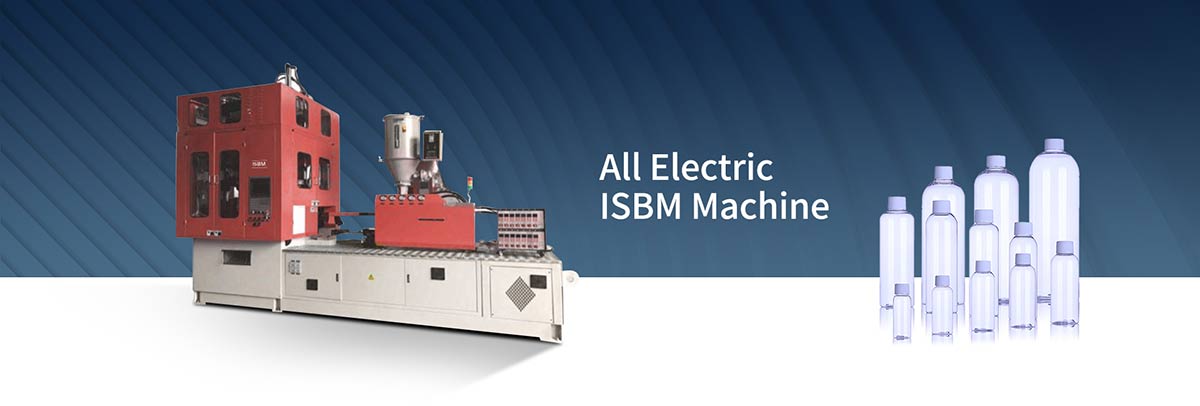
Injection blow molding is a plastic manufacturing technology that combines injection molding and blow molding to produce hollow containers with accurately formed necks, controlled dimensions and consistent surface quality.
The technology begins by forming a plastic preform around a metal core rod. Unlike an extruded tube, this preform is created inside an injection mold, allowing important features such as the bottle neck, thread and sealing surface to be defined before the container body is blown.
The preform remains supported by the core rod as it moves into a blow mold. Compressed air then expands the still-formable plastic outward until it follows the shape of the blow mold cavity.
This combination of precision injection molding and hollow-body blow molding is what defines injection blow molding, commonly abbreviated as IBM.
In conventional IBM, the container is formed without the controlled axial stretch-rod stage used in injection stretch blow molding.
This distinction is important because injection blow molding is not simply another name for injection molding, extrusion blow molding or injection stretch blow molding. It is a separate bottle-forming technology with its own tooling architecture, thermal behavior and container-design principles.
What Is Injection Blow Molding?
Injection blow molding is a manufacturing method in which a thermoplastic preform is first injection molded around a core rod and subsequently expanded inside a blow mold to create a hollow plastic article.
One of the defining characteristics of the technology is that the neck and finish of the container are created during the injection stage rather than being formed primarily during blowing.
That gives the process an important engineering advantage.
The body of a bottle needs to be hollow, lightweight and capable of expanding into a three-dimensional shape. The neck, however, may need accurate threads, a reliable sealing surface and repeatable dimensions.
Injection blow molding allows these two requirements to be handled differently.
The injection stage establishes the precision features.
The blowing stage establishes the hollow bottle body.
This principle explains why IBM has long been associated with containers where the relationship between neck accuracy, bottle geometry and repeatable production is important. Academic and industrial references describe the same basic architecture: injection-mold the preform around a core, retain it on that core during transfer, blow it inside a second mold and then remove the finished container.
The Fundamental Principle Behind Injection Blow Molding
The easiest way to understand injection blow molding is to separate the container into two functional regions.
The first is the finish region.
This includes features such as the opening, sealing surface, neck geometry, thread and flange. These features are largely established while the plastic is confined between accurately machined injection-mold surfaces.
The second is the expandable body region.
This portion begins as a comparatively thick tubular section of the preform. Once transferred into the blow mold, compressed air pushes this material away from the core rod and toward the cooled cavity wall.
The final bottle therefore inherits characteristics from two different forming mechanisms.
Its neck geometry comes primarily from injection molding.
Its body geometry comes primarily from blow molding.
Understanding this relationship is more useful than viewing IBM simply as a sequence of machine movements.
The Core Rod Is Central to IBM Technology
The core rod is one of the most important components in injection blow molding.
During preform formation, the core rod helps define the internal geometry of the preform while the surrounding injection mold defines its outside geometry.
The same core also carries the preform from one molding stage to the next.
During blowing, an air passage through or associated with the core introduces compressed air into the preform.
The core rod therefore performs several functions within the same manufacturing cycle.
It participates in preform formation, supports the preform during transfer, helps maintain the relationship between the neck and body, and provides the route through which blowing air enters the container.
Traditional three-station IBM systems commonly arrange multiple sets of core rods around an indexing transfer head so injection, blowing and ejection can occur in parallel at different stations.
This architecture is one reason the process can operate as an integrated production system rather than as a series of unrelated machines.
Why the Neck Is Formed Before the Bottle Body
Bottle neck geometry is frequently more dimensionally demanding than the body of the bottle.
Threads must match the closure.
Sealing surfaces must contact the cap correctly.
The opening must remain sufficiently round.
The neck must also remain correctly aligned with the rest of the container.
Trying to create all of these features only through free expansion of hot plastic would provide less direct dimensional control.
Injection blow molding solves the problem by molding the neck before the main body is expanded.
Because the neck region is established during injection molding, it is not required to expand in the same way as the body during blowing.
This separation between a relatively fixed neck and an expandable body is a fundamental IBM design principle.
Jomar, for example, identifies accurate neck dimensions as one of the characteristic bottle attributes of the process, while engineering references similarly note that threads and neck flanges are directly produced during preform injection.
From Preform Geometry to Bottle Geometry
The final bottle does not begin with a miniature copy of the finished container.
Instead, engineers design a preform whose material distribution can develop into the required bottle geometry during blowing.
This creates an important relationship:
Preform Design → Material Distribution → Expansion → Cooling → Final Bottle
A thicker region in the preform does not automatically produce a proportionally thicker region in the finished bottle.
The material moves as the preform expands.
Different areas may experience different amounts of circumferential and longitudinal deformation.
Bottle diameter, shoulder shape, body length and base geometry all influence how the polymer is redistributed.
For this reason, preform design is not independent of bottle design.
A successful IBM bottle requires the preform, core rod and blow cavity to be engineered as a connected system.
Material Distribution During Blowing
When compressed air enters the preform, the hot polymer begins moving away from the core surface and toward the walls of the blow mold.
The amount of expansion is not necessarily identical throughout the container.
A large-diameter region generally requires more material movement than a narrow region.
A pronounced shoulder transition may behave differently from a straight cylindrical wall.
The base may also cool and deform differently from the sidewall.
The goal is therefore not simply to inflate the preform until it touches the mold.
The goal is to achieve an acceptable final distribution of plastic throughout the required bottle geometry.
This is one reason bottle development should consider the relationship between preform geometry and the intended container rather than evaluating either geometry independently.
Temperature Is a Forming Variable, Not Just a Heating Setting
Injection blow molding requires the preform to reach the blowing stage in a condition that allows controlled deformation.
If parts of the preform are too cold, they may resist expansion.
If the material is too hot or thermally unbalanced, excessive movement, deformation or poor wall distribution may occur.
The thermal condition of the core rod can also influence the preform.
Heat moves between the polymer, core rod, injection mold and surrounding tooling during the molding cycle.
For this reason, process stability depends not only on nominal barrel temperature but also on repeatable thermal conditions throughout the molding system.
Industrial IBM equipment commonly incorporates preform/core temperature management and blow-mold cooling because these thermal interactions directly influence repeatability.
Why Cooling Matters to Final Bottle Quality
Blowing determines the shape of the container, but cooling helps preserve that shape.
Once the expanding polymer reaches the blow-mold surface, heat begins transferring into the cooled tooling.
The bottle must remain sufficiently stable before the cavity opens.
If the part is removed before adequate dimensional stability is achieved, deformation can continue outside the mold.
If cooling is unnecessarily long, overall production efficiency can decrease.
Cooling therefore involves a balance between dimensional stability and cycle performance.
The design of the bottle also affects cooling behavior.
Thicker areas retain heat longer than thin areas.
Changes in base thickness, shoulder geometry or local wall distribution may therefore influence both bottle quality and cycle behavior.
Why IBM Can Produce Containers Without a Pinch-Off Seam
Injection blow molding forms the initial preform inside a closed injection mold rather than continuously extruding a hanging tube of molten plastic.
The preform already has a closed end when it is transferred to the blow mold.
Consequently, the blow mold does not need to pinch the bottom of an open extruded parison together in the same manner associated with conventional extrusion blow molding.
This is why IBM is commonly associated with little or no pinch-off scrap and no conventional bottom pinch weld.
Engineering references identify the absence of pinch-off scrap and bottom seams among the characteristic advantages of injection blow molding.
This characteristic influences appearance, material utilization and the geometry that designers can achieve.
Bottle Quality Begins Before Blowing
A common misunderstanding is that the blow mold alone determines the quality of an IBM container.
In reality, many characteristics of the finished bottle have already been influenced before blowing begins.
The injection stage establishes preform weight.
It determines the molded neck geometry.
It affects how evenly material is distributed around the preform.
It influences temperature distribution.
It can also affect gate condition and cavity-to-cavity consistency.
The blow stage inherits all of these conditions.
A variation introduced during injection does not necessarily disappear during blowing.
In many cases, the blow stage simply redistributes that variation across a much larger bottle surface.
This is why stable injection conditions are fundamental to stable blow-molded containers.
Preform Balance Becomes Bottle Balance
In a multi-cavity production system, each cavity should receive a sufficiently consistent amount of material under sufficiently consistent thermal conditions.
Imagine that one cavity produces a preform that is slightly heavier or hotter than another.
Both preforms may still form apparently acceptable containers.
However, their wall distributions, cooling behavior or dimensional stability may differ.
These differences become increasingly important during extended production runs.
Consistent IBM production therefore depends on controlling not only average bottle quality but also cavity-to-cavity variation.
Recent technical guidance from IBM equipment manufacturers similarly emphasizes checking cavity filling, bottle weights, wall distribution, cooling and preform temperature when troubleshooting production consistency.
The Relationship Between Blow Ratio and Container Design
The preform must expand enough to create the required bottle, but expansion cannot be considered independently of material behavior and wall distribution.
A narrow preform forming a much wider container experiences greater circumferential expansion than a preform closer to the final bottle diameter.
Container height also affects longitudinal material movement.
The combined geometry determines how much the material needs to redistribute before reaching the cavity.
This relationship is sometimes described through blow-up or expansion ratios.
Injection Blow Molding and Wall Thickness
Injection molding provides strong control over the geometry of the initial preform, but the final bottle wall is produced through expansion.
That distinction matters.
Wall thickness in the finished bottle depends on several interacting variables, including initial preform geometry, local expansion, material temperature, bottle shape and cooling.
IBM can therefore achieve repeatable and controlled bottle walls, but it should not be described as though the final hollow body were dimensionally constrained on both sides by solid mold surfaces.
The outside of the bottle is defined by the blow cavity.
The internal bottle surface is created indirectly as the material expands.
This is one reason preform engineering is so important.
Surface Quality and Mold Replication
As the inflated polymer contacts the surface of the blow cavity, the outside wall begins taking the form and texture of that cavity.
Tooling condition can therefore influence the external appearance of the container.
Cavity finish, venting, thermal balance and cooling consistency can all contribute to the resulting surface.
However, surface appearance cannot be separated entirely from the condition of the preform.
If expansion is uneven, the final visual result may vary even when the cavity itself is accurately manufactured.
Bottle quality is therefore produced through the interaction of tooling, material and molding conditions rather than any single component.
What Makes Injection Blow Molding Different From Ordinary Injection Molding?
Injection molding normally creates a part by filling the complete shape between mold surfaces with molten plastic.
Both the internal and external geometry can therefore be mechanically defined by the mold.
Injection blow molding uses injection molding differently.
Instead of injection molding the entire finished hollow container, it injection molds an intermediate preform.
That preform is subsequently expanded.
The technology therefore combines the dimensional control of injection molding where it is most useful with the geometric freedom of blow molding where a hollow body is required.
This hybrid manufacturing principle is the foundation of IBM.
How Injection Blow Molding Fits Within Blow Molding Technology
Injection blow molding belongs to the broader family of blow-molding technologies, but the method used to prepare and transform the starting form is different.
| Technology | Starting Form | Primary Body-Forming Principle | Distinguishing Feature |
|---|---|---|---|
| Injection Blow Molding | Injection-molded preform | Air expansion | Injection-formed neck and preform |
| Injection Stretch Blow Molding | Injection-molded preform | Axial stretching + radial blowing | Controlled stretching before/during blowing |
| Extrusion Blow Molding | Extruded parison | Air expansion | Extruded tube is captured by the blow mold |
The Role of the Blow Mold
The injection mold and blow mold perform different jobs.
The injection tooling defines the preform and precision neck features.
The blow mold defines the outer geometry of the finished container.
Its cavity establishes characteristics such as body shape, shoulder profile, external dimensions, base geometry and surface texture.
During production, the blow mold must also remove heat from the expanded polymer.
It is therefore both a forming tool and a thermal-control component.
A bottle design that appears simple geometrically may still require careful consideration of cooling distribution, venting and material flow during expansion.
The Role of the Preform Mold
The preform mold determines the starting condition from which the bottle will later develop.
It establishes the outer geometry of the preform while the core rod defines its internal shape.
Together they influence the amount of material available in different regions.
They also form the finish geometry that will remain on the finished bottle.
A successful preform mold must therefore achieve two objectives at once.
It must create accurate molded features.
It must also produce a thermally and geometrically suitable intermediate part for the following blowing operation.
That makes IBM preform tooling fundamentally different from tooling designed solely to make a finished injection-molded component.
The Importance of Neck and Core Alignment
Because the preform remains associated with the core during transfer, alignment influences the relationship between the neck and the expandable body.
If the system is not sufficiently concentric, material distribution may become asymmetric.
One side of the preform may have a different effective thickness or thermal condition than the other.
After expansion, relatively small preform differences can become more visible across the larger bottle body.
Accurate tooling, core positioning and repeatable indexing are therefore important parts of IBM technology.
What Types of Plastic Can Be Used?
Injection blow molding is a thermoplastic-processing technology rather than a process limited to one resin.
Industry equipment is used with polymers such as polyethylene, polypropylene and polystyrene, while PET, PETG and other materials can also be processed in suitable systems and under suitable conditions. Equipment manufacturers publish different resin capabilities depending on screw design, tooling, temperature management and machine architecture.
Explore Plastic Materials for Bottle Molding →
What Products Use Injection Blow Molding?
Injection blow molding is commonly associated with relatively small and precise hollow containers, including packaging used in pharmaceutical, personal-care, cosmetic, food, healthcare and technical applications.
Industry references particularly associate IBM with smaller containers where accurate neck geometry, consistent dimensions and clean bottle appearance are valued.
Technical Advantages of Injection Blow Molding
The engineering value of injection blow molding comes primarily from the way it separates precision feature formation from hollow-body formation.
Because the neck is injection molded, dimensions around threads and closure interfaces can be accurately controlled.
Because the initial preform is molded rather than cut from an extruded tube, the process avoids the conventional pinch-off operation associated with extrusion blow molding.
Because the preform remains supported during transfer, neck geometry and preform position can remain closely related.
Because injection, blowing and ejection can operate at separate stations simultaneously, the technology can also support repetitive automated production.
These characteristics explain why IBM continues to be used where container precision and repeatability are important.
Technical Limitations of Injection Blow Molding
Injection blow molding is not the correct manufacturing method for every hollow plastic product.
The geometry of the preform, the core rod and the transfer system places practical limits on the shapes that can be produced.
Very large hollow products are generally better suited to other molding technologies.
Complex integral handles can also be difficult because the preform must expand into a shape that remains compatible with the IBM forming mechanism.
In addition, the technology requires both injection and blow tooling.
The relationship among preform design, bottle geometry, tooling and thermal conditions also means that substantial changes in bottle design may require more engineering than simply changing a blow cavity.
Engineering literature similarly notes limitations involving large products, integral handles and certain complex constructions.
These limitations should be understood as part of technology selection rather than treated as disadvantages in isolation.
Injection Blow Molding Is a System, Not Just a Molding Stage
The most useful way to understand IBM is as an interconnected manufacturing system.
Plasticizing affects melt condition.
Injection affects preform weight and temperature.
The core rod affects geometry and thermal behavior.
Preform design affects material distribution.
Indexing affects repeatability.
Blowing affects expansion.
The blow mold affects final geometry and cooling.
Cooling affects dimensional stability.
Ejection completes the cycle without damaging the finished container.
A change in one part of this chain can affect the stages that follow it.
For this reason, stable bottle production is not created by optimizing injection pressure, blow pressure or mold temperature independently.
The complete process must remain balanced.
Three-Station IBM Architecture
A widely used injection blow molding architecture contains three operating stations arranged around an indexing transfer system.
At one station, preforms are injection molded.
At another station, previously produced preforms are blown.
At the remaining station, finished bottles are removed.
Because different sets of core rods occupy each station simultaneously, these operations can overlap during normal production.
After completion of the current cycle, the transfer head indexes and each set of cores moves to the next stage.
This three-station principle is well documented in both academic references and established IBM machinery designs.
Three-Station and Four-Station Systems
Although three-station IBM is a familiar architecture, injection blow molding equipment does not have to follow only one configuration.
Additional stations may be introduced for specialized thermal management, core conditioning or other process requirements.
Industry literature documents both three- and four-station IBM systems, with the additional station allowing functions such as core inspection or thermal conditioning depending on the system design.
Injection Blow Molding vs Injection Stretch Blow Molding
Injection blow molding and injection stretch blow molding share an important starting principle: both can begin with an injection-molded preform.
The major difference is what happens before or during final blowing.
Conventional IBM expands the form primarily through blowing.
ISBM adds controlled axial stretching, together with radial expansion.
That additional stretching changes material deformation and can create biaxial molecular orientation in suitable polymers.
The technologies should therefore not be treated as interchangeable names.
Why Injection Blow Molding Still Matters
Modern plastic packaging increasingly requires manufacturers to balance several objectives simultaneously.
Containers may need accurate closure interfaces.
Material use must be controlled.
Bottle quality must remain repeatable across many cavities and production cycles.
Automation must reduce unnecessary handling.
Tooling and machine behavior must also remain sufficiently stable for extended production.
Injection blow molding addresses these requirements through an integrated molding principle rather than through any single machine feature.
Its continued value comes from the relationship between injection-molded precision and blow-molded hollow geometry.
Understanding IBM Before Choosing Equipment
A machine should not be selected simply because a product is technically a plastic bottle.
The correct molding technology depends on the interaction among bottle geometry, resin behavior, neck requirements, container size, required properties and production objectives.
For this reason, understanding injection blow molding as a technology should come before comparing individual machine models.
If a bottle project is well suited to IBM, the next stage is to evaluate the required equipment architecture, mold configuration, cavity count and production capacity.
Frequently Asked Questions About Injection Blow Molding
What is injection blow molding?
Injection blow molding is a plastic manufacturing technology in which a preform is injection molded around a core rod and then expanded with compressed air inside a blow mold to form a hollow container.
What does IBM stand for in plastic molding?
IBM stands for Injection Blow Molding.
Is injection blow molding the same as injection molding?
No. Injection molding forms the final part directly inside an injection mold. Injection blow molding first injection molds a preform and then uses blow molding to expand that preform into a hollow container.
Why does injection blow molding produce accurate bottle necks?
The neck and finish are formed during the injection-molding stage while the plastic is constrained by accurately machined mold components. The body is subsequently expanded during blowing.
Does injection blow molding use a preform?
Yes. IBM begins with an injection-molded preform or parison formed around a core rod.
Does injection blow molding use a stretch rod?
Conventional injection blow molding does not use the same controlled axial stretch-rod operation that defines injection stretch blow molding.
Is injection blow molding suitable for every bottle?
No. Suitability depends on container geometry, size, resin, neck design, required bottle properties and production requirements.
What is the main difference between injection blow molding and extrusion blow molding?
The starting form is produced differently. IBM begins with an injection-molded preform, while extrusion blow molding begins with an extruded parison.
What determines wall thickness in injection blow molding?
Final wall distribution is influenced by preform geometry, material distribution, temperature, expansion, bottle geometry and cooling conditions.
Why is the core rod important?
The core rod helps define the inside of the preform, carries it between stages and provides or supports the air path used during blowing.
Conclusion
Injection blow molding combines two different forming principles to create a hollow plastic container.
Injection molding establishes the preform, neck and precision features.
Blow molding expands the body into its final shape.
Between those two stages, the core rod preserves the relationship among preform geometry, neck geometry and the subsequent blowing operation.
The technology is therefore best understood not simply as injection followed by air blowing, but as an integrated system in which preform design, temperature, core geometry, material distribution, blow-mold design and cooling all influence the finished container.
Understanding these principles provides the technical foundation for evaluating IBM materials, bottle designs, process conditions and production equipment.
For deeper information, continue with:
Injection Blow Molding Process – understand the detailed molding sequence and process control.
ISBM vs IBM – understand how injection blow molding differs from injection stretch blow molding.
Injection Blow Molding Machine – evaluate equipment architecture and machine solutions.
Materials – evaluate plastic resins for bottle production.
Applications – evaluate the molding technology for different container projects.