
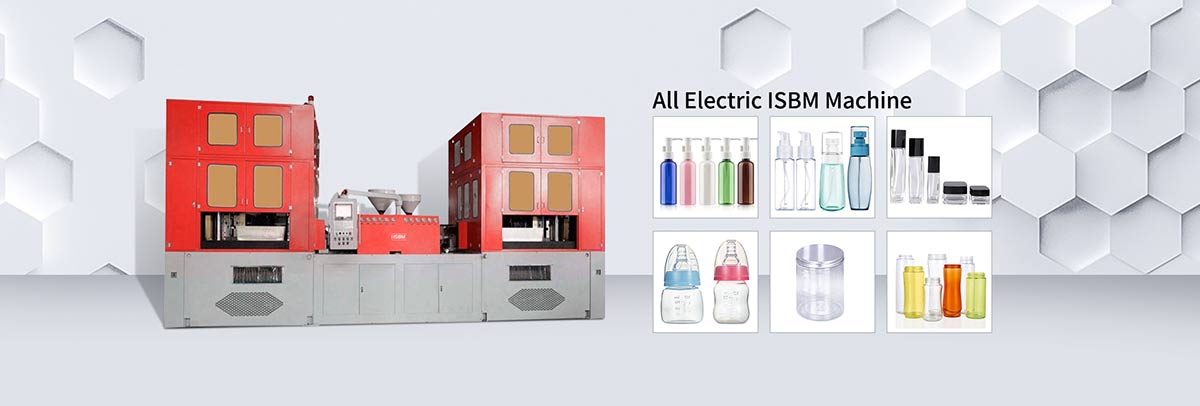
Injection Stretch Blow Molding & Injection Blow Molding Technology
From plastic resin to a finished bottle, successful molding depends on much more than the machine itself.
Material behavior, preform design, temperature distribution, injection accuracy, stretching, blowing, mold cooling and machine motion must work together as one controlled process.
At ISBM Machine, our bottle molding solutions are based primarily on two integrated technologies:
One-Step Injection Stretch Blow Molding, or ISBM, and Injection Blow Molding, or IBM.
Our machine platforms include 3-station and 4-station ISBM configurations, hydraulic, hybrid and all-electric drive systems, and equipment designed for bottle projects ranging from compact precision containers to large polycarbonate containers.
This Technology Center explains how these processes work, why different machine configurations exist, how material and bottle design affect machine selection, and how to choose the right molding technology for a specific bottle project.
Two Integrated Technologies for Plastic Bottle Production
Injection stretch blow molding and injection blow molding both integrate injection molding and blow molding into one manufacturing system, but the way the bottle is formed is different.
Understanding this difference is the first step in selecting the correct machine.
One-Step Injection Stretch Blow Molding - ISBM
One-step injection stretch blow molding combines preform injection molding, thermal management, axial stretching and blow molding within one integrated production cycle.
Plastic resin enters the machine as raw material.
The machine first injection molds the preform, including its finished neck geometry. Instead of producing a cold preform that must be stored and later reheated in a separate blow molding machine, the freshly molded preform remains within the same integrated molding system.
The thermal condition of the preform is then managed before it enters the stretch-blow stage.
During stretch blowing, a stretch rod extends the preform in the axial direction while compressed air expands it radially against the blow mold.
This combination of axial and radial deformation produces the characteristic biaxial stretching associated with ISBM.
The result is a finished bottle produced from resin within one integrated machine platform.
Typical process sequence:
Plastic Resin → Preform Injection → Thermal Conditioning → Axial Stretching → Blow Molding → Cooling → Finished Bottle
Injection Blow Molding - IBM
Injection blow molding also begins by injection molding a preform or parison around a core rod.
The molded parison is then transferred to a blow mold while it remains suitable for forming.
Compressed air expands the material against the blow mold cavity to create the final container shape.
Unlike ISBM, conventional injection blow molding does not use the axial stretch-rod stage that characterizes injection stretch blow molding.
Its basic process can therefore be summarized as:
Plastic Resin → Injection Molding → Blow Molding → Cooling → Ejection
IBM is commonly evaluated for projects requiring precision neck molding, stable container dimensions and integrated production of smaller hollow plastic containers.
The appropriate process depends on the material, bottle geometry, container size, required mechanical properties and production objective.
How One-Step Injection Stretch Blow Molding Works
A one-step ISBM machine should not be viewed simply as an injection machine connected to a blow molding station.
The quality of the finished bottle depends on how each molding stage influences the next.
Preform geometry affects stretching.
Injection temperature affects the thermal condition available for stretch blowing.
Stretch rod movement affects material distribution.
Blow timing affects wall thickness.
Mold temperature affects cooling and dimensional stability.
For this reason, ISBM is best understood as one continuous molding system.
Step 1 - Plasticization and Preform Injection
The process starts with the plastic resin.
Material is plasticized inside the injection unit until it reaches the required processing condition. The molten polymer is then injected into the preform mold.
This stage determines much more than the shape of the preform.
It also affects:
- preform weight consistency
- neck finish accuracy
- gate condition
- wall thickness distribution
- thermal history
- material homogeneity
- subsequent stretch behavior
The neck of the finished bottle is essentially formed during this injection stage.
For bottles requiring accurate thread geometry, sealing surfaces or neck dimensions, stable injection molding is therefore critical.
A well-designed preform provides the material distribution needed for the next stretch-blow stage.
A poorly designed preform cannot normally be corrected simply by increasing blow pressure.
Step 2 - Preform Thermal Management
The preform leaves the injection stage with thermal energy still present in the material.
One of the key characteristics of one-step ISBM is that this thermal condition can be used as part of the subsequent stretch-blow process.
Unlike a conventional two-step system, the preform does not normally need to be fully cooled, stored and later reheated from ambient temperature in a completely separate production process.
However, the preform temperature must still be controlled carefully.
Different areas of the preform may require different thermal conditions.
Important factors can include:
- preform surface temperature
- internal temperature
- neck temperature
- body temperature
- base temperature
- axial temperature distribution
- circumferential temperature distribution
The objective is not simply to make the preform “hot.”
The objective is to establish the temperature distribution required for controlled material stretching.
This becomes especially important when processing unusual bottle geometries, thick-wall preforms, different polymers or containers requiring more demanding wall-thickness distribution.
Step 3 - Axial Stretching
During the stretch-blow stage, a stretch rod enters the preform and extends it along the bottle axis.
This controlled axial movement begins redistributing material before and during blow expansion.
Stretch rod parameters may influence the finished container, including:
- stretch distance
- stretch speed
- stretch timing
- stretch rod position
- synchronization with blow air
The objective is to achieve the material distribution required by the bottle geometry.
The stretch stage is one of the principal technical differences between ISBM and conventional injection blow molding.
Step 4 - Radial Blow Expansion
While or after axial stretching begins, compressed air expands the preform radially toward the blow mold cavity.
The combination of axial stretching and radial expansion creates biaxial deformation of the material.
Correct coordination between the stretch movement and the blowing sequence is important for achieving stable bottle geometry and wall distribution.
Depending on the application and machine configuration, process parameters may include pre-blow timing, final blow pressure, air flow and blow duration.
Higher pressure alone does not automatically produce a better bottle.
The complete interaction between preform temperature, stretch movement, preform geometry and blow timing determines the molding result.
Step 5 - Mold Contact, Cooling and Bottle Stabilization
Once the expanding material contacts the blow mold surface, heat begins transferring from the bottle wall into the mold.
Cooling stabilizes the container geometry before removal.
Important factors can include:
- mold temperature
- cooling water temperature
- cooling channel design
- cooling time
- bottle wall thickness
- material characteristics
- bottle geometry
Insufficient cooling can contribute to dimensional instability or deformation after demolding.
Excessive cooling time, however, may reduce production efficiency.
The objective is therefore to achieve sufficient bottle stabilization while maintaining an efficient molding cycle.
Step 6 - Bottle Take-Out
After molding and cooling, the finished bottle is removed from the machine.
The bottle can then proceed to downstream operations such as inspection, leak testing, filling, printing, labeling, assembly or packaging.
The complete one-step ISBM process can therefore be summarized as:
Resin → Injection → Thermal Management → Stretch → Blow → Cool → Take-Out
3-Station vs 4-Station ISBM Technology
One of the most important decisions when selecting an ISBM machine is whether the bottle project is better suited to a 3-station or 4-station machine architecture.
The difference is not simply the number of stations.
It affects how the preform moves through the process and how much independent control is available between injection molding and stretch blowing.
3-Station ISBM Technology
A typical 3-station ISBM configuration integrates:
Injection → Stretch Blow → Take-Out
This architecture provides a relatively direct production sequence.
After injection molding, the preform proceeds toward the stretch-blow stage while retaining the thermal condition generated during injection.
For suitable bottle projects, this provides an efficient and compact one-step manufacturing platform.
3-station ISBM machines can be appropriate for many conventional bottle projects where material, bottle geometry and processing requirements match the available molding window.
Machines in this category may be available with different drive technologies and machine sizes depending on the bottle project.
50-V5 ISBM Machine
50-S6 All-Electric ISBM Machine
250-V3S Hybrid ISBM Machine
4-Station ISBM Technology
A 4-station ISBM machine adds an independent conditioning stage between injection and stretch blowing.
A typical process becomes:
Injection → Conditioning → Stretch Blow → Take-Out
The additional station provides another level of flexibility in managing the condition of the preform before stretch blowing.
This can be valuable when bottle geometry, material behavior, preform thickness or process requirements benefit from more independent thermal management.
The role of the conditioning station is therefore not simply to “heat the preform.”
Its purpose is to help establish the temperature distribution required for the subsequent stretch-blow process.
For some projects, the 4-station architecture can provide additional flexibility when managing complex bottles or materials.
4-station ISBM machines:
120-V4 4-Station ISBM Machine
120-S4 All-Electric 4-Station ISBM Machine
750-V4 Large-Container ISBM Machine
Is 4-Station ISBM Better Than 3-Station ISBM?
Not necessarily.
A 4-station machine should not automatically be considered superior to a 3-station machine.
The correct configuration depends on the bottle project.
Important selection factors include:
- plastic material
- preform geometry
- bottle volume
- bottle body diameter
- neck size
- bottle height
- wall-thickness requirements
- bottle shape
- required process flexibility
- target output
- required cavity number
For a relatively straightforward bottle project, a 3-station platform may provide an appropriate and efficient solution.
For another project, an independent conditioning stage may provide additional process flexibility.
The machine should therefore be selected around the bottle rather than selecting a bottle around the machine.
ISBM vs Injection Blow Molding
What Is the Main Difference Between ISBM and IBM?
The primary distinction is the stretching stage.
In ISBM, the preform is stretched axially with a stretch rod while it is expanded radially by blow air.
In conventional IBM, the injected parison is transferred to the blow mold and expanded without the separate axial stretch-rod process used in ISBM.
Technology Comparison
| Feature | ISBM | IBM |
|---|---|---|
| Preform/parison injection | Yes | Yes |
| Blow molding | Yes | Yes |
| Axial stretch rod | Yes | No conventional stretch stage |
| Radial expansion | Yes | Yes |
| Biaxial stretching | Yes | No conventional ISBM-style biaxial stretch stage |
| Integrated neck formation | Yes | Yes |
| One-machine process | Yes | Yes |
| Machine selection based on bottle project | Required | Required |
Neither technology is universally better.
The correct decision should be based on bottle geometry, material, container size, wall distribution, neck requirements, production objective and required bottle properties.
Hydraulic, Hybrid and All-Electric ISBM Technology
ISBM machines can use different drive architectures to control mold movements, indexing, injection, stretching and other machine functions.
At ISBM Machine, our equipment range includes hydraulic, hybrid and all-electric configurations.
The purpose of offering different drive systems is not to declare one technology universally superior.
Different factories have different priorities.
Some customers value familiar hydraulic maintenance.
Others prioritize servo control, cleaner operation or reduced dependence on hydraulic components.
The correct architecture depends on the application and production environment.
Hydraulic ISBM Technology
Hydraulic systems have been widely used in plastics processing machinery for many years.
They provide a proven and familiar platform for manufacturers that already have experience maintaining hydraulic equipment.
Potential advantages include:
- established technology
- strong force capability
- familiar maintenance procedures
- broad technician familiarity
- suitability for many conventional production environments
Hydraulic ISBM platforms can remain a practical choice where the factory already operates hydraulic molding machinery and has established maintenance capability.
Related Machines:
50-V5
120-V4
Hybrid ISBM Technology
Hybrid machine architecture combines different drive technologies within one machine platform.
The objective is to use each drive system where it provides the most appropriate balance of force, control, energy performance and machine cost.
Depending on machine design, servo-controlled motion may be used for selected movements while hydraulic systems continue to perform other machine functions.
A hybrid solution can therefore provide a middle path between traditional hydraulic architecture and fully electric machine design.
Related Machine:
250-V3S
All-Electric ISBM Technology
All-electric ISBM machines use servo-driven systems instead of relying primarily on conventional hydraulic actuation for machine movements.
For suitable applications, this architecture can provide advantages such as:
- precise motion control
- high movement repeatability
- reduced hydraulic components
- reduced dependence on hydraulic oil
- cleaner machine environment
- lower operating noise potential
- simplified control of repeatable machine movements
All-electric technology can be particularly attractive for customers seeking greater servo control, cleaner production environments or a modern alternative to conventional hydraulic platforms.
Machine selection must still be based on the bottle project rather than drive technology alone.
Related Machines:
50-S6 All-Electric ISBM Machine
120-S4 All-Electric ISBM Machine
Hydraulic vs Hybrid vs All-Electric - Which Should You Choose?
The answer depends on more than energy consumption.
Consider:
production environment,
maintenance capability,
machine size,
required bottle size,
process requirements,
motion-control priorities,
capital investment,
local service capability,
and long-term operating strategy.
Our engineering team can recommend a machine architecture after evaluating the bottle and production requirement.
Core Technologies Behind Stable Bottle Production
Stable bottle production is the result of multiple controlled processes working together.
A successful ISBM project cannot normally be optimized by changing only one parameter.
The following technology areas should be considered as one integrated system.
Precision Preform Injection
The preform establishes the starting geometry and material distribution for the final bottle.
Important factors include:
injection stability,
shot consistency,
melt condition,
preform weight,
neck geometry,
gate condition,
and mold temperature.
Variations introduced during injection can appear later as bottle-quality problems during stretch blowing.
Preform Thermal Management
The stretchability of the preform depends strongly on its thermal condition.
The objective is to maintain or establish an appropriate temperature distribution before blowing.
A preform that is too cold in one area and too hot in another may stretch unevenly.
Temperature control should therefore be considered together with preform geometry and material characteristics.
Stretch Rod Control
The stretch rod helps control axial material distribution.
Its movement must be coordinated with the bottle height, preform length, blow timing and desired wall distribution.
Important parameters may include position, speed, timing and total stretch distance.
Blow Air Control
Blow pressure, timing and air flow influence how the preform expands against the mold.
The objective is controlled expansion rather than simply maximum pressure.
The correct blowing sequence depends on the preform, bottle geometry and material.
Mold Temperature and Cooling Control
The mold does more than define the bottle shape.
It also removes heat from the molded container.
Cooling performance influences:
- cycle stability
- bottle dimensions
- demolding behavior
- surface quality
- container deformation
Cooling design should therefore be considered during both machine and mold engineering.
Motion Synchronization and Process Repeatability
An ISBM machine performs several highly coordinated movements during every production cycle.
Injection, indexing, mold opening and closing, stretch movement, blowing, cooling and take-out must operate in a repeatable sequence.
Stable motion control helps maintain consistent process timing from cycle to cycle.
This becomes particularly important in high-volume manufacturing where small variations repeated over thousands of cycles can affect overall production quality.
Material Processing Technology
ISBM machine selection must always be considered together with material behavior.
Different polymers have different processing temperatures, stretch behavior, cooling requirements and bottle-performance characteristics.
For this reason, a material should never be selected only because another bottle manufacturer is using it.
The bottle design, application and machine configuration must be evaluated together.
PET Processing
PET is one of the best-known materials associated with stretch blow molding.
Its processing behavior makes preform design, temperature control and stretch ratio particularly important.
Depending on the bottle application, PET projects may require attention to:
- preform geometry
- material drying
- injection condition
- temperature distribution
- stretch ratio
- wall-thickness distribution
- bottle clarity
PETG Processing
PETG can be selected for applications where visual appearance, clarity and bottle design are important.
Its behavior is different from conventional PET, so process parameters should not simply be copied from PET production.
The appropriate machine configuration and process window should be evaluated around the actual bottle.
PP Processing
Polypropylene has a different thermal and stretching behavior from PET.
Successful PP bottle molding therefore requires process conditions developed specifically around PP rather than applying PET parameters directly.
The machine, preform design, bottle geometry and temperature control strategy should be evaluated together.
Polycarbonate Processing
Polycarbonate is an important material within our current ISBM machine range.
PC can be evaluated across our machine platforms depending on bottle geometry, size and production requirements.
It is especially important for large reusable water-container applications.
For our current 5-gallon bottle solution, the 750-V4 is designed around polycarbonate bottle production.
At present, PC is the material used for our 5-gallon ISBM bottle solution.
Information:
Polycarbonate Material Guide
5-Gallon Water Bottle Application
750-V4 ISBM Machine
Not Every Plastic Is Suitable for Every ISBM Project
A common mistake is assuming that any thermoplastic used for bottle production can automatically be processed efficiently on the same ISBM platform.
That is not the case.
Material suitability depends on:
- rheological behavior
- processing temperature
- stretch characteristics
- bottle geometry
- wall thickness
- neck design
- required output
- machine configuration
For example, polyethylene materials such as PE are widely used in plastic bottle manufacturing, but they should not automatically be treated as equivalent to PET, PP, PETG or PC within an ISBM process.
Our current ISBM and IBM solutions should be evaluated against the specific material and bottle project before machine selection.
How Process Control Affects Bottle Quality
The purpose of machine technology is not simply to complete a molding cycle.
The real objective is to produce a bottle that consistently meets the customer’s specifications.
Many bottle-quality problems can be traced back to the interaction between material, preform design, temperature, stretching, blowing and cooling.
Uniform Wall Thickness
Wall-thickness distribution depends on several factors, including:
preform geometry,
material distribution,
preform temperature,
stretch ratio,
stretch rod movement,
blow timing,
and final bottle shape.
Changing only blow pressure is rarely the complete solution to an uneven wall-thickness problem.
Bottle Clarity
For transparent bottles, visual quality can be affected by:
material condition,
drying,
injection parameters,
melt history,
temperature distribution,
stretch behavior,
cooling,
and contamination.
A clear bottle therefore depends on both material preparation and stable molding control.
Accurate Neck Dimensions
Because the bottle neck is primarily created during injection molding, neck accuracy depends heavily on the injection mold and injection process.
Important factors can include:
mold precision,
material shrinkage,
injection stability,
cooling,
and mold temperature.
This is one reason integrated injection-based bottle processes can be attractive for containers requiring well-controlled neck geometry.
Stable Bottle Dimensions
Bottle dimensions depend on more than the blow mold cavity.
Cooling, material shrinkage and demolding condition all affect the finished container.
Stable process timing and mold temperature can therefore be important for maintaining dimensional consistency.
Consistent Bottle Weight
Bottle weight is established primarily during the preform injection stage.
Stable injection control is therefore important for maintaining bottle-to-bottle weight consistency.
Common ISBM Bottle Problems and Their Possible Causes
When a molding problem occurs, the visible defect is often only the final symptom.
The root cause may originate several stages earlier in the process.
Uneven Wall Thickness
Possible areas to investigate include preform design, temperature distribution, stretch-rod alignment, stretch timing and blow sequence.
Bottle Whitening
Possible factors may include material condition, excessive local stretching, inappropriate temperature or unsuitable process settings.
Haze or Reduced Clarity
Possible areas to investigate include material drying, polymer condition, melt temperature, thermal history, mold temperature and stretching conditions.
Bottle Deformation
Possible causes may include insufficient cooling, unsuitable demolding temperature, wall-thickness distribution or material shrinkage.
Uneven Bottle Base
Possible factors may include preform geometry, stretch position, temperature distribution, mold design or blow timing.
Neck Deformation
Because the neck is formed during the injection stage, excessive heat or unsuitable process conditions later in the cycle may affect dimensional stability.
Off-Center Material Distribution
Possible causes may include preform geometry, stretch rod alignment, temperature imbalance or mold alignment.
Troubleshooting should always consider the complete molding process rather than adjusting a single parameter in isolation.
One-Step ISBM vs Two-Step Stretch Blow Molding
Both one-step and two-step technologies can produce high-quality plastic bottles, but their production concepts are different.
One-Step ISBM
In a one-step system, resin is converted into a preform and then into a finished bottle within the same integrated machine process.
The preform retains thermal energy from the injection stage and continues through the molding process without being fully manufactured, stored and later processed on a separate blow molding line.
Two-Step Stretch Blow Molding
In a conventional two-step process, preforms are produced separately.
They are cooled and can be stored or transported.
The preforms are later reheated in a separate stretch blow molding machine before being formed into bottles.
Which Process Is Better?
Neither process is universally superior.
The decision depends on:
production scale,
bottle design,
material,
required flexibility,
preform sourcing strategy,
factory layout,
product changeover,
and business model.
One-step ISBM can be especially attractive to manufacturers seeking integrated resin-to-bottle production within one machine system.
Technology Selection Starts With the Bottle
We do not recommend selecting an ISBM or IBM machine based only on machine tonnage or catalog specifications.
The correct selection starts with the bottle.
Our engineering evaluation typically begins with the following information.
Bottle drawing or physical sample
↓
Plastic material
↓
Bottle volume
↓
Body diameter
↓
Overall height
↓
Neck diameter and neck finish
↓
Bottle geometry
↓
Required wall distribution
↓
Target output
↓
Required cavity number
↓
ISBM or IBM process
↓
3-Station or 4-Station architecture
↓
Hydraulic, Hybrid or All-Electric platform
↓
Recommended machine and mold solution
Why Bottle Geometry Matters
Two bottles with the same volume may require very different machines.
A 500 mL narrow cylindrical bottle and a 500 mL wide cosmetic bottle may have different:
- preform requirements
- stretch ratios
- body diameters
- mold dimensions
- cooling requirements
- cavity arrangements
Machine selection should therefore never be based on bottle volume alone.
Why Neck Size Matters
The neck is formed during injection molding.
Neck diameter affects the injection mold, core system, preform geometry and available machine configuration.
A large-neck jar or container may require a different solution from a narrow-neck bottle of similar volume.
Why Material Matters
A machine that can physically mold a bottle of a certain size may not automatically provide the correct process for every plastic material.
Material behavior must be evaluated together with:
preform design,
temperature control,
stretch ratio,
mold cooling,
and bottle geometry.
Technology by Bottle Application
Technology selection becomes easier when the bottle application is considered together with the material and machine.
Cosmetic and Personal Care Bottles
Typical priorities may include:
high visual quality,
clear or premium appearance,
stable neck dimensions,
complex bottle shapes,
and surface consistency.
Potential machine selection depends on material, size and geometry.
Pharmaceutical and Healthcare Containers
Projects may prioritize:
dimensional consistency,
controlled neck geometry,
repeatability,
clean production environment,
and stable process control.
All-electric machine architecture may be considered for projects where reduced hydraulic components or cleaner machine operation is particularly valuable.
Large Polycarbonate Water Bottles
Large reusable water containers present a different molding challenge from small PET bottles.
Bottle size, wall distribution, mold dimensions, cooling and machine architecture become more important as container size increases.
For our current 5-gallon water bottle solution, the 750-V4 is designed specifically around large PC bottle production.
Information:
5-Gallon Water Bottle Production
Polycarbonate ISBM Technology
750-V4 Large-Container ISBM Machine
Food and Beverage Bottles
Machine selection depends on the bottle volume, material, shape, output and required bottle properties.
PET and other suitable materials should be evaluated according to the specific application.
Technology Knowledge Center
This Technology Hub is the starting point for more detailed technical resources.
Explore the individual technology topics below when evaluating a new bottle project or optimizing an existing production line.
Recommended Technology
One-Step ISBM Technology
Understand the complete resin-to-bottle production process.
Injection Blow Molding Technology
Learn how integrated injection and blow molding differs from ISBM.
3-Station ISBM Technology
Understand the operating principles and applications of 3-station machine architecture.
4-Station ISBM Technology
Learn how an independent conditioning station increases process flexibility.
3-Station vs 4-Station ISBM
Compare the two machine architectures.
All-Electric ISBM Technology
Learn how servo-driven machine systems differ from hydraulic platforms.
Hydraulic ISBM Technology
Understand the characteristics of conventional hydraulic machine systems.
Hybrid ISBM Technology
Explore machine architectures combining different drive technologies.
Hydraulic vs Hybrid vs All-Electric ISBM
Compare machine drive systems for different production environments.
Preform Temperature Conditioning
Learn why thermal distribution is critical before stretch blowing.
Biaxial Stretching Technology
Understand axial and radial material orientation.
Stretch Blow Molding Process Control
Explore stretch speed, blow timing and material distribution.
Bottle Wall Thickness Control
Understand the relationship between preform design, temperature and stretching.
ISBM Mold Technology
Learn how injection molds, conditioning components and blow molds work together.
ISBM vs Injection Blow Molding
Compare the two integrated bottle-production technologies.
One-Step vs Two-Step Blow Molding
Understand the difference between integrated resin-to-bottle production and separate preform/blowing systems.
ISBM Troubleshooting
Identify possible causes of common molding defects.
Connect Technology, Material, Application and Machine
1. What Technology Does the Bottle Need?
ISBM or IBM?
3-station or 4-station?
Hydraulic, hybrid or all-electric?
Explore Technology
2. What Material Will Be Used?
PET?
PETG?
PP?
PC?
Another material requiring feasibility evaluation?
3. What Bottle Will Be Produced?
Cosmetic bottle?
Pharmaceutical container?
Food bottle?
Wide-neck container?
Large PC water bottle?
4. Which Machine Fits the Project?
Machine selection should follow the bottle, material and process evaluation.
From Bottle Drawing to Production Solution
A machine quotation is more useful when it is based on a real bottle project.
If you are planning a new production line, send us your bottle information before selecting the machine.
Our engineering team can evaluate:
bottle drawing,
bottle sample,
material,
capacity,
body diameter,
height,
neck dimensions,
target output,
number of cavities,
and production requirements.
Based on this information, we can help evaluate:
the molding process,
machine architecture,
machine model,
mold configuration,
and technical feasibility.
Send Us Your Bottle Drawing
You do not need to determine the machine model yourself.
Send us the bottle you want to produce.
We will evaluate the project from the perspective of material, geometry, molding process and machine configuration.
Frequently Asked Questions About ISBM Technology
What is injection stretch blow molding?
Injection stretch blow molding is an integrated bottle manufacturing process in which a preform is first injection molded and then stretched axially and expanded radially inside a blow mold.
The combined stretching process forms the final bottle.
In a one-step ISBM system, injection molding and stretch blowing are integrated into the same machine platform.
What is one-step ISBM?
One-step ISBM converts plastic resin into a finished bottle within one integrated machine process.
The preform is injection molded and continues through the molding system while retaining thermal energy from the injection stage.
It is subsequently conditioned as required and stretch blown into the final container.
Does one-step ISBM require reheating?
One-step ISBM does not use the same separate full cooling, storage and independent reheating cycle associated with conventional two-step bottle production.
The freshly injection-molded preform retains thermal energy from injection.
Depending on machine configuration and bottle requirements, this temperature may be conditioned or redistributed before stretch blowing.
What is the difference between injection stretch blow molding and injection blow molding?
ISBM uses a stretch rod to extend the preform axially while blow air expands it radially.
Conventional injection blow molding does not use the same axial stretch-rod stage.
This is one of the fundamental differences between the two processes.
What is biaxial stretching?
Biaxial stretching means that the material is stretched in two directions.
In ISBM, the preform is stretched along its axis by the stretch rod and expanded radially by compressed air.
This combined deformation occurs during formation of the bottle body.
What is the difference between 3-station and 4-station ISBM?
A typical 3-station ISBM machine integrates injection, stretch blowing and bottle take-out.
A 4-station ISBM machine adds an independent conditioning stage between injection and stretch blowing.
The additional station can provide greater flexibility for managing the preform’s thermal condition before final forming.
Is a 4-station ISBM machine always better than a 3-station machine?
No.
The correct machine architecture depends on the bottle geometry, material, preform design, size, wall distribution and production requirement.
Many bottle projects can be produced effectively on a 3-station machine, while others may benefit from the additional conditioning flexibility of a 4-station platform.
What is the difference between hydraulic and all-electric ISBM machines?
Hydraulic machines use hydraulic systems for major machine movements and force generation.
All-electric machines rely more extensively on servo-driven motion systems.
All-electric architecture can provide precise movement control, reduced hydraulic components and cleaner machine operation.
The appropriate choice depends on the production environment and bottle project.
Which materials can be processed by ISBM?
Material suitability depends on both the polymer and the bottle project.
Our ISBM solutions can be evaluated for materials including PET, PETG, PP and PC depending on machine configuration, bottle geometry and production requirements.
Material feasibility should always be confirmed before machine selection.
Can PE be processed on an ISBM machine?
Polyethylene is widely used in blow molded packaging, but it should not automatically be assumed to be suitable for every ISBM configuration.
PE material behavior differs from materials commonly associated with stretch blow molding.
The application, bottle geometry, material grade and molding process should be evaluated individually before machine selection.
What material is used for 5-gallon bottles on the 750-V4?
Our current 750-V4 5-gallon bottle solution is designed around polycarbonate bottle production.
For this application, PC is currently the material used with our machine solution.
How do I choose the correct ISBM machine?
Start with the bottle rather than the machine model.
Provide the bottle drawing, material, volume, body diameter, height, neck dimensions, target output and cavity requirement.
Our engineering team can then evaluate whether the project is more suitable for ISBM or IBM, 3-station or 4-station architecture, and hydraulic, hybrid or all-electric machine technology.
Let the Bottle Define the Machine
The best ISBM solution does not begin with a machine catalog.
It begins with the bottle you want to produce.
Send us your bottle drawing, sample or project requirements, and our engineering team will evaluate the appropriate material, molding process, machine architecture and model.
Start Your Bottle Project
Tell us:
Bottle material
Bottle volume
Bottle dimensions
Neck size
Target output
Required cavities
Application
Country of installation
We will help determine an appropriate production solution.