
ISBM machines / Equipment configuration
Three-Station ISBM Machines
A three-station ISBM machine is a configuration to assess when the bottle, preform and tooling can work within an injection, stretch-blowing and take-out sequence. Selecting this architecture requires more than counting stations: review the resin grade, preform thermal condition, mold interfaces and required accepted output together. The 120-V3 provides a documented three-station reference, but its specifications do not establish compatibility with every bottle or an existing mold.
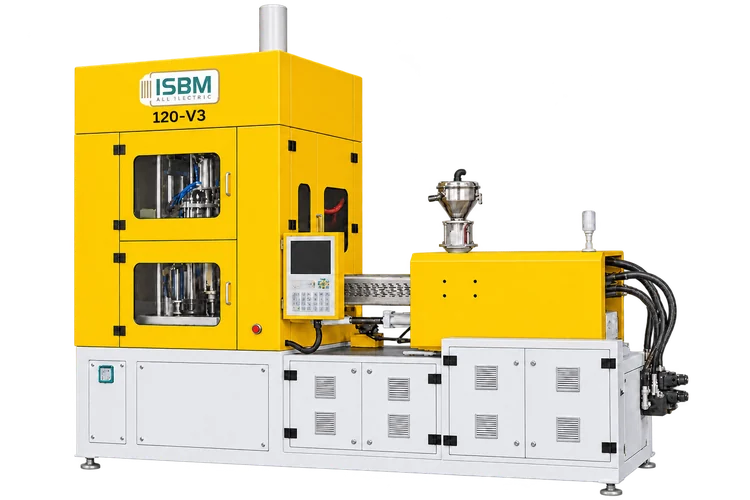
120-V3 three-station machine. See the documented model starting point below.
What happens at the three stations?
01 Preform injection
The injection tool forms the preform using the selected resin and cavity arrangement. The shot and neck tooling must match the intended container.
02 Stretch blowing
The preform is stretched and blown in the configured process. Thermal suitability must be established for the bottle and resin, not assumed from the station count.
03 Take-out
The container is removed using the agreed neck handling and removal arrangement. Check clearance and product handling against the mold drawing.
Thermal review
The 120-V3 public sequence does not show a separate conditioning station. Ask how preform temperature is managed in the proposed process; do not assume another manufacturer’s three-station method applies.
A documented model starting point
The 120-V3 three-station machine is a starting point for a bottle-specific review. Its public specification identifies a 50 mm screw and 440 cm³ theoretical injection volume. These are injection-unit references, not guarantees of usable shot mass or finished-bottle output.
Keep the model, resin grade and proposed tooling together. The material list on the model page is a catalog reference, not proof that every grade has been tested. Do not transfer the data to another three-station model or treat a larger nominal injection volume as inherently better for a small shot.
Three-station machine selection worksheet
| Selection item | Evidence to bring | Decision to record |
|---|---|---|
| Bottle envelope | Body, neck, height and weight from one drawing | One complete compatible cavity arrangement, not mixed limits |
| Preform thermal condition | Resin grade and proposed preform/process | How the preform reaches the required stretch-blowing condition |
| Injection unit | Required total preform shot and selected screw | Usable shot and processing configuration for this resin |
| Mold interfaces | Mounting, neck-ring and original-machine drawings | Required adaptations, strokes and removal clearance |
| Accepted output | Trial conditions and rejection criteria | Bottles meeting the agreed quality criteria per unit time |
Complete the worksheet for each proposed bottle. It is an assessment structure, not a completed trial record or a compatibility certificate.
Check the complete mold set
An existing tool is not compatible merely because both machines have three stations. Review the injection tool, neck rings, blow tool and take-out arrangement. Mounting dimensions, opening strokes and product clearance need to be checked against the actual machine and mold drawings.
State whether a new mold is proposed or an existing mold is to be assessed. Include its original machine reference and any modifications already made. The scope should distinguish tooling work from machine changes and identify who approves the final interfaces.
When is a separate conditioning position worth reviewing?
If the proposed bottle requires thermal control that has not been demonstrated within the three-station process, include a four-station configuration in the engineering comparison. The 120-V4 describes a separate conditioning position and a different injection specification. It is an alternative configuration, not automatically a better machine.
Compare the same bottle, resin, output definition and tooling scope. Keep any cycle-time or quality comparison attached to recorded test conditions. This category page identifies three-station selection requirements; the model pages retain the detailed specifications.
Questions before selecting the machine
Does three stations mean three cavities?
No. Stations describe process positions. Cavity count describes the mold arrangement and must be selected using the complete bottle and shot requirements.
Can an existing mold be reused?
Only after checking its mounting, neck handling, required movements and removal arrangement against the proposed machine. Supply the original drawings rather than relying on a general compatibility claim.
Is the catalog resin list a trial result?
No. A named material is a starting point for assessment. Confirm the exact grade, preparation method and production configuration through the project review and trial.
Discuss Your ISBM Bottle Project
Share the bottle drawing, exact resin grade, neck dimensions, target weight and required accepted output. Include existing mold drawings when tooling reuse is part of the assessment.
The review should identify the proposed configuration, evidence needed and project-specific limitations before a supply commitment is made.