
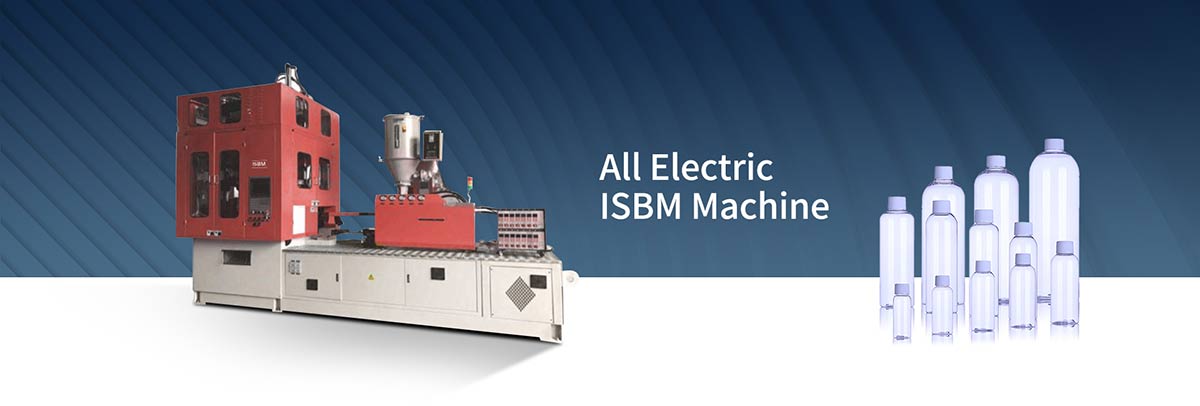


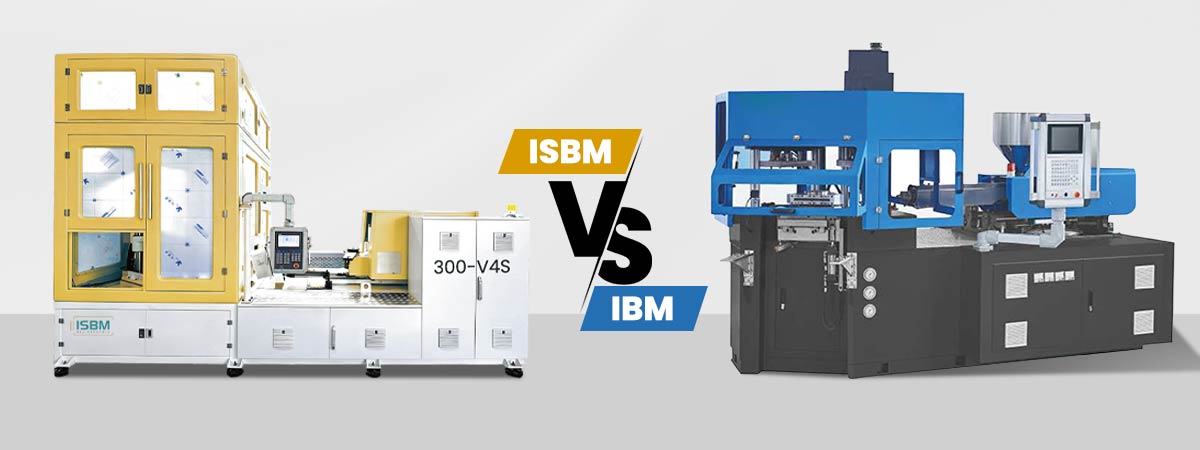
ISBM vs IBM: Injection Stretch Blow Molding vs Injection Blow Molding
Injection Stretch Blow Molding (ISBM) and Injection Blow Molding (IBM) are two manufacturing processes used to produce hollow plastic containers directly from plastic resin.
At first glance, the two technologies look very similar. Both begin by injection molding a preform or parison around a core rod, transfer the hot plastic into a blow mold, inflate it into the final bottle shape, and eject the finished container.
The critical difference is stretching.
In an ISBM process, the preform is mechanically stretched in the axial direction while compressed air expands it radially inside the blow mold. This stretching process can create molecular orientation in two directions, commonly referred to as biaxial orientation.
In a conventional IBM process, the injection-molded parison is transferred into the blow mold and inflated without the same axial stretch-blow operation.
This difference affects much more than the machine structure. It influences bottle strength, wall thickness, transparency, material selection, container geometry, tooling design, production economics and the applications for which each technology is best suited.
Neither process is universally better.
The correct choice depends on what bottle you want to manufacture.
For manufacturers evaluating an ISBM machine vs IBM machine, the most important question should therefore not be:
“Which machine is better?”
The better question is:
“Which molding process is more suitable for my bottle, resin, production volume and quality requirements?”
This guide explains the differences in detail.
What Is Injection Blow Molding (IBM)?
Injection Blow Molding, normally abbreviated as IBM, combines injection molding and blow molding into one integrated manufacturing process.
The process normally consists of three basic stages:
Injection molding → Blow molding → Ejection
Plastic resin is first melted inside the injection unit. The molten resin is injected into a preform mold around a core rod. The injection mold precisely forms the bottle neck and creates the tubular body that will later become the finished container.
The core rod then carries the hot preform into the blow mold.
Compressed air enters through the core rod and expands the plastic until it contacts the walls of the blow mold. After sufficient cooling, the mold opens and the finished bottle is removed.
Jomar describes the conventional IBM process as a three-stage system using injection, blowing and ejection stations around a rotary transfer arrangement. The company also highlights injection-molded neck dimensions as one of the important characteristics of the process.
Because the neck is completely injection molded rather than formed during the blowing stage, IBM is particularly useful for containers requiring accurate neck finishes.
Typical applications include pharmaceutical bottles, medicine bottles, dropper bottles, cosmetic containers, personal-care bottles, tablet bottles and other small precision containers.
What Is Injection Stretch Blow Molding (ISBM)?
Injection Stretch Blow Molding, abbreviated as ISBM, adds a controlled stretching operation to the bottle-forming process.
In a typical one-step ISBM process, plastic resin enters the machine and finished bottles leave the machine without producing and storing cold preforms separately.
Depending on machine architecture, the process may include injection, preform conditioning, stretch-blow molding and bottle ejection.
After the preform is injection molded, it is transferred while its temperature remains suitable for stretching.
Inside the blow mold, a stretch rod moves into the preform and stretches it in the longitudinal direction. At approximately the same stage, compressed air expands the preform outward against the blow mold.
The material is therefore stretched:
Vertically by the stretch rod and radially by blowing air.
This controlled orientation is one of the main reasons ISBM is widely used for PET and other materials where bottle strength, transparency and lightweight construction are important.
Nissei ASB describes its machines as one-step injection stretch blow molding systems capable of producing finished containers directly from resin. Its current equipment is used with materials including PET, PP, PC, PEN, PLA and recycled PET, depending on the machine and application.
ISBM vs IBM: The Main Difference
The fundamental difference between ISBM and IBM can be summarized simply:
IBM blows the injection-molded preform into the final container.
ISBM stretches and blows the injection-molded preform into the final container.
That additional stretching stage changes the way the polymer is distributed and oriented inside the finished bottle.
As a result, ISBM can provide significant advantages for certain materials and container designs, especially when manufacturers require a high strength-to-weight ratio, good transparency and controlled wall distribution.
For other products, particularly small bottles with precision necks, relatively simple geometries or materials such as PP and PE, conventional injection blow molding may be the more appropriate solution.
ISBM vs IBM Comparison
| Comparison | ISBM | IBM |
|---|---|---|
| Full Name | Injection Stretch Blow Molding | Injection Blow Molding |
| Basic Process | Injection + stretching + blowing | Injection + blowing |
| Preform Formation | Injection molded | Injection molded |
| Stretch Rod | Yes | Normally no axial stretch rod |
| Molecular Orientation | Can create biaxial orientation | Limited compared with ISBM |
| Typical PET Applications | Very strong | Possible, but machine/process dependent |
| PP Applications | Possible | Very common |
| PE Applications | Application and machine dependent | Common on conventional IBM equipment |
| PC Applications | Possible on suitable ISBM systems | Machine dependent |
| Bottle Transparency | Excellent with suitable transparent resin | Depends strongly on resin and process |
| Lightweighting Potential | Particularly attractive for oriented containers | Depends on bottle geometry and material |
| Neck Precision | Excellent because neck is injection molded | Excellent because neck is injection molded |
| Wall Distribution | Controlled through preform design, conditioning and stretching | Controlled primarily through preform/core design and blowing |
| Typical Products | PET bottles, cosmetic bottles, pharmaceutical bottles, food containers, specialty bottles | Pharmaceutical bottles, dropper bottles, cosmetic bottles, pill bottles, personal-care bottles |
| Bottle Shape Capability | Round, oval, flat, wide-mouth and complex shapes depending on tooling | Round, oval and various specialty shapes depending on tooling |
| Best Choice | High-performance stretched containers | Precision injection-blown containers |
The table should be treated as a general process comparison rather than an absolute machine specification. Modern machines increasingly expand traditional processing boundaries. For example, specialized IBM equipment can process PET, while modern one-step ISBM machines can process materials other than PET.
1. Difference in the Molding Process
The easiest way to understand ISBM vs IBM is to follow the plastic from raw resin to finished bottle.
IBM Process
In IBM, resin is plasticized in the injection unit and injected around a core rod.
The injection mold determines the preform weight, neck geometry and much of the material distribution.
Once injection is completed, the core rod carrying the hot preform moves to the blow station. The blow mold closes around the preform and compressed air expands it to the final container shape.
The bottle is subsequently cooled and transferred to the ejection station.
The process is compact and highly repeatable when the bottle, mold, material and machine are correctly matched.
An important advantage is that the bottle neck is formed during injection molding. This gives manufacturers precise control over thread geometry, sealing surfaces and other neck features.
For pharmaceutical, healthcare and personal-care packaging, this can be particularly valuable.
Jomar lists accurate neck dimensions, consistent weight and tight tolerances among the characteristics associated with injection blow molding.
ISBM Process
ISBM begins in a similar way.
The resin is melted and an accurately controlled preform is injection molded.
The important difference appears during bottle formation.
Instead of simply inflating the hot preform, an ISBM machine uses a stretch rod to elongate the preform while blowing pressure expands it radially.
Correct preform temperature is extremely important.
If the preform is too cold, stretching can become difficult or uneven.
If it is too hot, the material may stretch excessively, causing poor wall distribution or dimensional instability.
The machine must therefore coordinate injection conditions, preform temperature, stretch-rod movement, blowing pressure and mold cooling.
This additional process control is one reason ISBM machines can produce sophisticated lightweight containers but also require careful bottle and preform engineering.
2. Stretching and Molecular Orientation
This is the most important technical distinction between the two processes.
When suitable thermoplastic material is stretched under the correct temperature conditions, polymer chains can become more highly oriented.
In ISBM, stretching occurs both longitudinally and radially.
This is why the process is commonly associated with biaxially oriented bottles.
For PET bottles in particular, orientation can help manufacturers achieve strong, lightweight and transparent containers.
Nissei ASB states that containers made using injection stretch blow molding can provide advantages in light weight, strength and transparency, while also benefiting from accurately molded bottle necks.
IBM does not normally use the same stretch-blow mechanism.
The bottle is expanded by blowing the preform into the cavity, but there is no equivalent controlled axial stretch ratio produced by a stretch rod.
Consequently, ISBM and IBM can produce bottles with distinctly different mechanical characteristics even when their final external appearance looks similar.
3. Material Differences: ISBM vs IBM
Material selection is one of the first things that should be evaluated before choosing between the two processes.
PET
PET is strongly associated with injection stretch blow molding.
Its ability to respond well to controlled stretching makes it an excellent material for transparent and lightweight containers.
PET ISBM bottles are widely used in food, beverage, cosmetics, pharmaceuticals, personal care and many specialty packaging applications.
However, it would be incorrect to say that PET can only be processed by ISBM.
Specialized injection blow molding machines can also process PET. Jomar, for example, offers IBM equipment specifically configured for PET while retaining the ability to process more traditional IBM resins.
The question is therefore not simply whether PET can be processed.
The more useful question is what bottle performance, geometry, wall distribution and production economics are required.
Polypropylene – PP
PP can be processed using both technologies when the machine, mold and process are designed accordingly.
IBM is widely used for PP pharmaceutical, healthcare, food and personal-care containers.
ISBM can also produce PP bottles and containers.
PP stretch blow molding, however, requires suitable processing conditions because its thermal behavior differs from PET.
Machine capability should always be confirmed against the specific PP grade, bottle design and required production rate.
Polyethylene – PE
HDPE and LDPE are traditionally important materials for injection blow molding.
Typical IBM applications include pharmaceutical bottles, personal-care containers and other small packages.
Jomar identifies HDPE, LDPE and PP among the common materials used for a range of injection-blown containers.
For ISBM, polyethylene is not normally the first material customers associate with conventional stretch-blow production.
However, machine technology continues to develop, so material suitability should always be evaluated against the specific equipment platform rather than assumed solely from the process name.
Polycarbonate – PC
PC is another material that can be processed by suitable injection stretch blow molding equipment.
It is particularly important in applications where toughness, heat resistance or large reusable container requirements justify its use.
For specialized applications such as large water containers, machine design, preform heating and stretching capability become especially important.
Other Engineering and Specialty Resins
Depending on machine configuration, ISBM can also process materials such as PEN, PLA, PES, PPSU and other specialty polymers.
Nissei ASB lists several of these materials across its current one-step equipment range.
This illustrates an important purchasing principle:
Never select an ISBM or IBM machine based only on the generic process name.
Machine screw design, injection unit, heating system, core rod design, stretch system, blow pressure, mold temperature control and software all influence which materials can actually be processed reliably.
4. Bottle Strength
Bottle strength is one of the strongest reasons manufacturers consider ISBM.
Because the material can be oriented during stretching, a properly designed ISBM bottle can achieve excellent mechanical properties while using relatively little material.
This creates the possibility of reducing bottle weight without simply making the bottle structurally weak.
The actual result depends on several factors, including preform design, resin grade, stretch ratio, wall distribution, bottle shape and processing conditions.
IBM bottles can also be strong and durable.
The difference is that IBM achieves bottle performance primarily through resin selection, preform geometry, wall thickness and container design rather than through the same degree of stretch orientation.
Therefore, a thicker IBM bottle is not necessarily inferior to a thinner ISBM bottle.
They are simply different engineering solutions.
5. Bottle Transparency and Appearance
For transparent packaging, especially with PET, ISBM is often highly attractive.
Correctly processed PET can produce clear, glossy containers suitable for cosmetics, pharmaceuticals, food, beverages and premium packaging.
ISBM is therefore frequently selected when shelf appearance is an important part of the product.
IBM can also produce transparent bottles when suitable resins such as PET, SAN or other transparent materials are used.
However, the appearance of the finished bottle depends on much more than whether the process is called IBM or ISBM.
Material grade, mold polishing, processing temperature, cooling and wall thickness all affect visual quality.
6. Neck Accuracy
Both ISBM and IBM have an important advantage over processes in which the bottle neck is primarily formed through blowing:
the neck is injection molded.
The injection mold can accurately define threads, sealing surfaces, tamper-evident features and neck dimensions.
IBM is particularly well known for this benefit.
Jomar notes that injection blow molding can achieve tight neck-finish tolerances required for applications such as tamper-resistant closures and other precision packaging.
ISBM retains the same fundamental benefit because the neck section is also formed during injection molding and generally does not undergo the same stretching as the bottle body.
This makes both technologies suitable for applications requiring reliable closure fit.
7. Wall Thickness and Material Distribution
Wall distribution is controlled differently in the two processes.
With IBM, engineers primarily design the injection-molded preform around the final bottle geometry.
The amount of resin placed in different areas of the preform has a strong influence on the finished wall distribution after blowing.
With ISBM, preform design remains essential, but stretching introduces additional variables.
The final bottle wall is affected by preform geometry, preform temperature distribution, stretch-rod speed, stretch timing, pre-blow timing, blowing pressure and bottle geometry.
This gives ISBM engineers substantial control over material distribution, but it also means process development can be more demanding.
A successful ISBM project should therefore consider the bottle, preform, mold and machine as one integrated system.
8. Bottle Weight and Lightweighting
When manufacturers want to reduce packaging weight, ISBM can be particularly attractive.
Stretch orientation can enable the designer to use material more efficiently.
Instead of relying entirely on thick walls for mechanical performance, engineers can optimize material distribution and molecular orientation.
This can reduce resin consumption per bottle.
At large production volumes, even a small reduction in bottle weight can become economically significant.
For example, reducing only one gram from a bottle produced in very large quantities can translate into substantial annual resin savings.
However, lightweighting should never be evaluated using bottle weight alone.
A lighter bottle must still pass the required top-load, drop, leak, sealing, transportation, filling and shelf-life tests.
9. Typical Applications for IBM
IBM remains extremely important in packaging sectors where small container sizes, accurate neck finishes and consistent dimensions are priorities.
Common applications include pharmaceutical containers, tablet and pill bottles, dropper bottles, cosmetic bottles, healthcare packaging, roll-on containers, personal-care packaging and small food or household containers.
Jomar states that IBM containers range from very small formats into liter-scale applications and are widely used across pharmaceutical, healthcare, personal-care, beauty, food, beverage and household markets.
The process is especially attractive when a manufacturer needs a highly controlled bottle finish and the product does not require the stretch orientation provided by ISBM.
10. Typical Applications for ISBM
The application range of modern ISBM equipment is very broad.
Typical products include pharmaceutical bottles, cosmetic bottles, personal-care packaging, food bottles, beverage containers, liquor bottles, jars, healthcare containers, baby-feeding bottles and specialty industrial containers.
Modern one-step machines can also produce round, oval, flat, wide-mouth, thick-wall and complex bottle geometries.
Current ASB equipment, for example, is marketed for applications ranging from pharmaceuticals and cosmetics to foods, household products and industrial containers, illustrating how broadly one-step ISBM technology can now be applied.
For manufacturers considering ISBM, bottle size alone should therefore not determine the decision.
The material, geometry and performance requirements matter more.
11. Machine Structure: ISBM Machine vs IBM Machine
A conventional IBM machine commonly uses a rotary or indexing mechanism to move core rods between injection, blowing and ejection stations.
The core rods are critical components because they help form the inside of the preform and transport it between stations.
An ISBM machine has similar requirements but adds the systems required to prepare and stretch the preform.
Depending on the design, this may include a dedicated conditioning station and stretch rods inside the blow station.
Four-station one-step ISBM machines often separate the process into:
Injection → Conditioning → Stretch-Blow → Ejection
The conditioning station gives engineers greater control over preform temperature before stretching.
Other machine architectures may combine or organize these operations differently.
Therefore, buyers should not assume that every ISBM machine has exactly the same number of stations.
What matters is how effectively the machine controls the complete molding process.
12. Mold Differences
Tooling is a major investment for both technologies.
An IBM project normally requires an injection/preform mold, core rods and a blow mold.
An ISBM project also requires injection/preform tooling and blow tooling, while stretch-blow operation introduces additional considerations related to stretch rods and preform conditioning.
For both technologies, tooling quality directly influences bottle quality.
Poor tooling can result in inconsistent bottle weights, poor neck dimensions, wall-thickness variation, flash, cooling problems and unstable production.
A machine supplier should therefore evaluate the bottle and mold together rather than recommending a machine based only on nominal bottle volume.
13. Production Speed
It is tempting to ask whether ISBM or IBM is faster.
There is no universal answer.
Production output depends on the number of cavities, bottle weight, material, cooling requirements, machine size, mold design, bottle geometry and cycle conditions.
For a small lightweight bottle, a high-cavity machine may achieve very high production rates.
For a thick-wall specialty container, the cycle may be limited by cooling.
Machine speed should therefore be compared using the actual target bottle rather than a generic dry-cycle specification.
When asking for a machine quotation, provide the supplier with the bottle drawing, bottle weight, resin specification, required output and neck dimensions.
Only then can realistic production output be calculated.
14. Energy Consumption
Energy consumption also cannot be determined simply by choosing ISBM or IBM.
Modern equipment may use conventional hydraulics, servo-hydraulics, hybrid-electric systems or fully electric drives.
All-electric and servo-driven machines can reduce energy consumption during certain operating conditions compared with conventional fixed-speed hydraulic equipment.
For example, current ISBM equipment includes all-electric and hybrid-electric platforms, while IBM manufacturers also offer servo-hydraulic systems designed to reduce power consumption.
When comparing energy consumption, manufacturers should request a figure based on an actual production test wherever possible.
The useful metric is not simply machine motor power.
It is:
Energy consumed per 1,000 acceptable bottles.
That figure provides a much more meaningful basis for comparing equipment.
15. Scrap and Secondary Finishing
Both injection-based blow molding technologies can offer important advantages in this area.
Because the bottle neck and preform are created by injection molding, IBM normally avoids the flash trimming associated with some extrusion blow molding applications.
Jomar highlights no trimming and very low process scrap as advantages of IBM.
ISBM likewise produces the bottle from a precisely injection-molded preform, so normal bottle production does not require cutting away neck flash in the same way as conventional extrusion blow molding.
This can simplify downstream production and improve material utilization.
16. Which Process Is Better for PET Bottles?
For many PET applications, ISBM is the first process manufacturers should evaluate.
This is particularly true when the project requires a transparent bottle, lightweight design, good mechanical strength and controlled wall distribution.
PET responds very effectively to stretch orientation, which is why injection stretch blow molding has become so closely associated with PET packaging.
That does not mean IBM is incapable of processing PET.
Specialized IBM equipment is available for PET production.
The final selection should depend on bottle geometry, volume, wall thickness, production target and the reason PET has been specified in the first place.
If the main objective is to exploit PET’s stretch-oriented properties, ISBM is usually the more natural technology to investigate.
17. Which Process Is Better for PP Bottles?
Both processes deserve consideration.
IBM has a long history of producing PP pharmaceutical, healthcare and personal-care packaging.
For many small PP bottles with precision neck finishes, conventional injection blow molding is a very logical solution.
ISBM may become attractive when the bottle design can benefit from stretching, specific wall distribution or other characteristics available from a stretch-blow process.
The project should therefore be evaluated using actual samples or drawings rather than material name alone.
18. Which Process Is Better for Pharmaceutical Bottles?
Both IBM and ISBM are widely used in pharmaceutical and healthcare packaging.
IBM is particularly strong in small pharmaceutical bottles, pill containers and dropper bottles where accurate neck geometry and consistent dimensions are important.
ISBM becomes attractive when pharmaceutical packaging also requires high transparency, lightweight construction, specific materials or bottle geometries that benefit from stretching.
Cleanliness requirements must also be considered.
Modern equipment can be configured for clean production environments, but machine construction, lubrication, air treatment, mold design and material-handling systems all influence the final production environment.
19. Which Process Is Better for Cosmetic Bottles?
Cosmetic packaging can use either technology.
The decision often depends on appearance and bottle design.
For transparent PET cosmetic bottles, ISBM is frequently a strong candidate because it can combine transparency, surface quality and lightweight construction.
IBM is well suited to many smaller cosmetic and personal-care containers, particularly those using PP, PE or other traditional IBM materials.
Special shapes such as oval bottles can be produced using both technologies when the correct machine and tooling are selected.
20. Can ISBM Produce Wide-Mouth Jars?
Yes.
Modern one-step ISBM machines are capable of manufacturing wide-mouth containers and jars.
The maximum neck diameter depends on the individual machine, injection configuration and mold.
One-step ISBM is therefore not limited to traditional narrow-neck beverage bottles.
Current commercial equipment is used for wide-mouth food jars, cosmetic containers and other specialty packaging.
21. Can IBM Process PET?
Yes.
This is an important point because the common statement that “IBM cannot process PET” is too simplistic.
PET processing requires appropriate machine capability and processing conditions.
Specialized IBM machines are commercially available specifically for PET while retaining compatibility with more traditional IBM materials.
However, simply because PET can be run on an IBM machine does not mean IBM and ISBM will produce identical bottles.
The absence or presence of stretch orientation remains a major process difference.
22. ISBM vs IBM Machine Cost
Machine price should not be used as the only selection criterion.
An ISBM system may require more process-control functionality because injection, temperature conditioning, stretching and blowing must work together.
An IBM machine has a different mechanical architecture and may appear simpler for some projects.
However, actual investment depends on machine size, injection capacity, drive technology, automation, number of cavities, mold construction, auxiliaries and bottle requirements.
The correct comparison is therefore not:
ISBM machine price vs IBM machine price.
It should be:
Total cost per acceptable bottle over the expected production period.
A useful economic evaluation includes machine investment, mold investment, electricity, compressed air, cooling water, resin consumption, labor, maintenance, scrap rate, cycle time and expected machine utilization.
A machine costing less initially can become more expensive over several years if it consumes more resin or produces fewer acceptable bottles.
23. How to Choose Between ISBM and IBM
Before purchasing equipment, start with the bottle rather than the machine.
Define the resin, bottle capacity, weight, neck diameter, body diameter, bottle height, transparency requirements, wall-thickness target and required annual output.
Then determine what performance the container must achieve.
Does it require high clarity?
Does it need to be extremely lightweight?
Does the bottle need precise threads?
Does it require unusual wall thickness?
Will it be hot filled?
Does it require high drop strength?
Is it round, oval, flat or wide-mouth?
Will multiple bottle designs share the same machine?
Once these parameters are known, an equipment manufacturer can evaluate whether ISBM or IBM is technically and economically more appropriate.
For many projects, sending the machine manufacturer a physical bottle sample, 2D drawing or 3D file is much more useful than simply asking for a machine based on bottle volume.
ISBM vs IBM: Practical Selection Guide
As a general starting point, consider ISBM first when the project involves PET, transparency, lightweight construction, stretch-oriented bottle performance or packaging in which bottle strength relative to material weight is especially important.
Consider IBM first when producing small precision containers, particularly in pharmaceutical, healthcare, personal-care and similar markets where injection-molded neck accuracy and conventional IBM resins are important.
For PP projects, either technology may be appropriate.
For PET projects, ISBM is generally the natural starting point, but specialized IBM technology should not automatically be excluded.
For specialty engineering plastics, machine-specific processing capability must be confirmed with the equipment manufacturer.
There is no reliable shortcut that replaces evaluating the actual bottle.
ISBM vs IBM vs Extrusion Blow Molding
ISBM and IBM should also be distinguished from Extrusion Blow Molding, or EBM.
EBM first extrudes a hot hollow tube called a parison. A mold closes around that parison and compressed air blows it into the final shape.
Because the parison is extruded rather than injection molded around a core rod, the process has different strengths.
EBM is especially useful for products such as handle bottles, large HDPE containers and many irregular hollow products.
IBM and ISBM, by contrast, create the preform using injection molding.
This gives them particular advantages in neck precision.
ISBM then adds controlled stretching to obtain another level of material orientation.
Therefore, these three technologies should not be treated as interchangeable blow molding processes.
They solve different packaging problems.
Frequently Asked Questions About ISBM vs IBM
What does ISBM stand for?
ISBM stands for Injection Stretch Blow Molding. It combines injection molding with controlled stretching and blow molding to manufacture hollow plastic containers.
What does IBM stand for in plastic bottle manufacturing?
IBM stands for Injection Blow Molding. An injection-molded preform or parison is transferred into a blow mold and inflated to produce the finished bottle.
What is the biggest difference between ISBM and IBM?
The biggest difference is the stretching operation. ISBM uses a stretch rod to elongate the preform while it is blown outward, whereas conventional IBM blows the injection-molded preform without the same controlled axial stretching operation.
Is ISBM only used for PET?
No. PET is the best-known material for ISBM, but modern machines can also process materials such as PP, PC, PEN, PLA and various engineering plastics depending on machine configuration.
Can IBM make PET bottles?
Yes. Specialized IBM machines can process PET. The resulting process, however, remains different from stretch blow molding because conventional IBM does not provide the same axial stretching operation.
Is IBM suitable for pharmaceutical bottles?
Yes. IBM is widely used for pharmaceutical and healthcare containers, particularly smaller bottles requiring accurate injection-molded neck finishes.
Is ISBM suitable for pharmaceutical bottles?
Yes. ISBM is also widely used for pharmaceutical packaging, particularly when transparency, PET construction, lightweighting or particular bottle geometries are required.
Which process produces stronger bottles?
The answer depends on resin, bottle design and wall thickness. For materials such as PET, ISBM can use stretch orientation to achieve an excellent strength-to-weight ratio. IBM can also manufacture very durable containers but develops their properties through a different combination of material and wall design.
Which process uses less plastic?
There is no universal answer, but ISBM can provide strong lightweighting opportunities for suitable stretch-oriented bottles. The comparison should be made using finished bottles that satisfy the same performance requirements.
Which process has more accurate bottle necks?
Both processes can provide excellent neck accuracy because the neck is injection molded. IBM is particularly well known for precision neck-finish applications.
Is ISBM more expensive than IBM?
Not necessarily. Machine and mold investment depends on equipment size, configuration, automation, cavities and bottle design. Total production cost should be calculated per acceptable bottle rather than comparing machine purchase price alone.
Can the same machine produce different bottle shapes?
Yes, within the machine’s molding range. Different bottle projects normally require different molds, although tooling strategies may allow some components to be shared. Machine injection capacity, neck diameter, body diameter, bottle height and mold dimensions must all be checked.
Conclusion: ISBM or IBM?
ISBM and IBM share the same basic principle of creating an injection-molded preform before blow molding, but the addition of controlled stretching makes them fundamentally different bottle-manufacturing technologies.
Injection Blow Molding is especially valuable for precision small containers, accurate injection-molded neck finishes and many pharmaceutical, healthcare, cosmetic and personal-care applications.
Injection Stretch Blow Molding adds axial stretching to the blowing process, making it particularly attractive for PET and other applications requiring transparent, lightweight and high-performance containers.
The correct process depends on the complete bottle specification rather than one variable such as material or capacity.
Before choosing an ISBM or IBM machine, evaluate:
material, bottle geometry, bottle weight, neck specification, wall distribution, required output, mold cavities, container performance and total production cost.
The most reliable machine selection therefore begins with a bottle drawing or sample.
Need Help Choosing Between an ISBM and IBM Machine?
If you are planning a new plastic bottle production project, send us your bottle specifications for a technical evaluation.
Please provide your bottle sample or drawing, resin, bottle capacity, bottle weight, neck diameter, body diameter, bottle height and required production output.
Our engineering team can evaluate whether an Injection Stretch Blow Molding machine or Injection Blow Molding machine is the more suitable solution and recommend an appropriate machine and mold configuration.